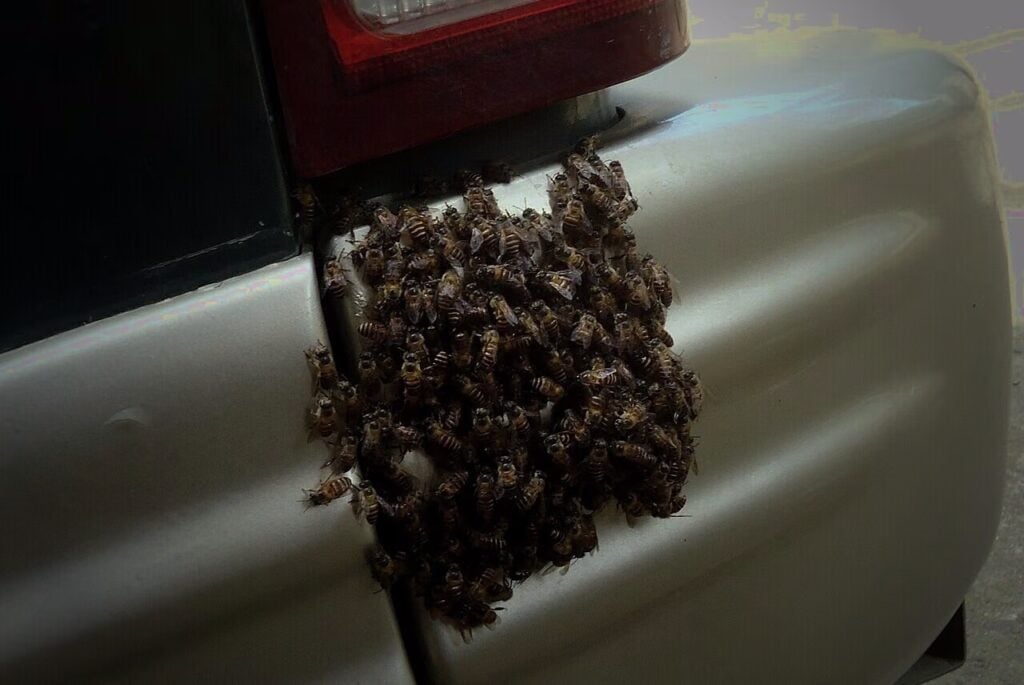
You wake up swatting at the air. Your skin is crawling, your heart is going like a jackhammer, and for a few seconds you genuinely cannot tell if the things you were dreaming about followed you out of the dream. Then you look around, the bedroom is quiet, and you realize it was all in your head.
If you have had a dream about being attacked by a swarm of insects, you are in good company. It is one of the more common nightmares people report, and it tends to stick with you long after you wake up. So what is your brain trying to tell you? Let’s dig into it, because there is more going on here than just a scary night.

What Does It Mean to Dream About Being Attacked by Insects?
A dream about a swarm of insects usually points to feeling overwhelmed by something in your waking life. The swarm is rarely about the bugs themselves. It is about pressure that has piled up until it feels like it is coming at you from every direction at once.
Think about how a swarm actually behaves. It is not one threat you can look in the eye and deal with. It is a hundred tiny things, all moving at once, impossible to fight off individually. That is exactly how a lot of us feel when too much lands on our plate at the same time.
This idea goes back a long way. The 2nd-century Greek diviner Artemidorus of Daldis wrote the *Oneirocritica*, a five-book guide to interpreting dreams that is one of the oldest surviving works of its kind. He treated a swarm of insects as a bad omen of people conspiring against the dreamer, a crowd of hostile voices rather than a single enemy. When you read it that way, the symbolism has barely changed in nearly two thousand years.
Meanwhile in the Islamic tradition, the 7th-century scholar Ibn Sirin became famous for his dream interpretations, and he argued that the same dream could mean different things depending on who was having it. A dream of insects might signal wealth or patience in one person, and overwhelming burden in another. His point was that context matters more than the symbol itself.
Why Insects Are Such a Powerful Dream Symbol
So the meaning shifts with the dreamer. But there is a reason insects carry so much weight to begin with, and it reaches back much further than any single interpretation. Insects carry a very old association with things that multiply beyond our control. That is true in real life, and it is even more true in folklore and mythology, where insects have been tied to plague, decay, and invasion for thousands of years.
There is a practical reason for that, and the locust is the proof. A locust is not really a separate animal from a grasshopper. It is a grasshopper that has physically transformed because of overcrowding. When their populations get dense enough, the constant jostling against each other triggers a release of serotonin in their brains, and the insect literally changes colour, eats far more, and breeds more easily. The solitary creature becomes a swarming one. It is one of the strangest transformations in the animal kingdom, and it happens because the insect was touched too many times by the crowd around it.
The results are genuinely staggering. One swarm of Rocky Mountain locusts in 1875, recorded by a physician named Albert Child, was estimated at 12.5 trillion insects across nearly 200,000 square miles. Even allowing for the rough math of a 19th-century estimate, that is an insect cloud larger than the state of California. Some plagues have been so devastating that they caused famines, and one in 1915 contributed to roughly 200,000 deaths in the Mount Lebanon region.
When something can arrive in those numbers and strip a region bare, it leaves a mark on the human imagination. That is the baggage insects bring when they turn up in a dream. They represent the small stuff that will not stay small.
The Most Common Swarm Scenarios and What They Suggest
So the swarm carries weight for a reason. The next question is whether it matters which insect is doing the swarming. As it turns out, it does. Different insect swarms tend to line up with different kinds of pressure in your life. Here are the ones that come up most often, and what they may be pointing at.
- Bees.. Bees bring a mixed message. They can mean busyness, a hive-mind environment like a demanding workplace, or feeling like you cannot get a moment to yourself. A swarm of bees is often about feeling pulled in too many directions by other people.
- Wasps or hornets.. These tend to carry more of a sting, which often lines up with feeling criticized, ganged up on, or attacked by words rather than actions.
- Ants.. Ants are relentless and organized. An ant dream often points to obligations that keep marching in, or a feeling of being one small part of a machine you cannot slow down.
- Mosquitoes.. These are less about overwhelming and more about being drained. A mosquito swarm dream often shows up when you feel something is quietly taking more from you than you are getting back.
- Flies.. Flies are drawn to decay and mess, so they often show up when something has been left too long, a situation you have not dealt with, or a lingering annoyance you keep waving away instead of addressing.
- Beetles.. Hard-shelled and stubborn, beetles in a dream often represent a problem that will not budge no matter how you approach it.
- Mixed or unidentifiable bugs.. When you cannot even tell what they are, that often means you cannot quite name what is bothering you yet. It is an unnamed pressure.
The Word “Nightmare” Comes From a Creature That Sits on Your Chest
If insects carry that much weight for us, it makes sense that they have shaped our language too. Our word for the worst kind of dream is a case in point. The history of the word nightmare is itself about being attacked in your sleep. It has nothing to do with female horses. The “mare” in nightmare is an old Germanic and Slavic folk spirit, a demon believed to creep into bedrooms and settle on a sleeper’s chest, bringing terror and a feeling of being crushed or unable to move.
That description is a near-perfect match for what doctors now call sleep paralysis, where a person wakes up aware but unable to move, often sensing a heavy presence in the room. For centuries, people explained that experience as an attack by something unseen. The word only widened to mean any bad dream around 1829.
So when a swarm dream wakes you up in a cold sweat, you are sharing an experience that people have been trying to explain for a very long time, sometimes with demons, sometimes with omens, and sometimes with medicine.
The Attack Itself Matters More Than the Bugs

That old idea of being pinned and helpless turns out to be a useful way to read the dream itself. How the attack plays out tells you more about the meaning than the type of insect does. The feeling in the dream is the message.
Ask yourself a few questions about what you actually experienced. Were you being bitten and stung, or just chased? Were you swatting and fighting back? Were you frozen in place? Could you see them clearly, or were they a dark blur? Did you get away, or did the dream just stop?
Being unable to fight back often lines up with a situation where you feel you have no leverage. Constant stinging often matches a stream of small irritations or criticisms coming at you. Being trapped by a swarm tends to show up when your obligations have no obvious exit. And if you managed to escape or wake yourself up, that is often a sign you are already finding your way out of something.
What Your Dream Bugs Might Be Telling You
All of that description is well and good, but it does not help much at three in the morning. So here is what the dream is actually pointing you toward. The swarm is usually a sign that you need to break one big overwhelming thing into smaller pieces. Here is the practical takeaway, and I think this is the most useful part.
When you are inside an overwhelming situation, everything arrives at once and it all feels equally urgent. But a swarm is not actually one creature. It is many separate small ones. If your dream is showing you a swarm, that is often your mind asking you to stop trying to fight all of it at once. So a swarm is not really a thing you fight. It is a thing you sort through, one small piece at a time, until the number finally drops.
Consider what has been piling up lately. Is there a deadline you keep pushing? An awkward conversation you have not had? A pile of small tasks that has quietly turned into a mountain? Very often, the moment you write those things down and deal with them one at a time, the swarm feeling dissolves.
If You Genuinely Fear Insects, the Dream Will Hit Harder
There is one group for whom this advice is much harder to follow, though. People with a real fear of insects tend to have much more intense versions of this dream. There is a clinical name for that fear. Entomophobia is a recognised specific phobia, an excessive or unrealistic fear of one or more classes of insect.
It comes with its own vocabulary, too. Katsaridaphobia is a fear of cockroaches. Melissophobia is a fear of bees. Myrmecophobia is a fear of ants. Spheksophobia is a fear of wasps. Lepidopterophobia is a fear of moths and butterflies. The entomologist Jeffrey Lockwood, who has written extensively about human attitudes toward insects, cites an estimate that around six percent of people in the United States have some form of this phobia.
If that is you, a swarm dream is not just a bad night. It is your brain taking your daytime fear and running it at full volume while your guard is down. If insect dreams are showing up often enough to wreck your sleep, that is a pattern worth talking to a doctor about, especially if you have not treated the phobia itself.
When Insect Swarm Dreams Keep Coming Back
For most people these dreams pass. But for some, the swarm keeps returning, night after night, and that changes the picture. Recurring swarm dreams are worth paying attention to. A one-off nightmare is usually just your brain clearing out the day. The same dream showing up again and again is different.
Sigmund Freud treated dreams as disguised wish-fulfilment, a way for repressed feelings to sneak past the mind’s defences. Carl Jung disagreed that it was always about wishes, seeing dreams instead as the unconscious trying to communicate with the waking self, often through symbols he called archetypes. Jung would have looked at a swarm dream and asked whether the swarm represented something in you that you had refused to face.
Modern sleep medicine takes a more practical angle. Recurring nightmares are generally treated as unresolved stress rather than random noise, which is why a technique called imagery rehearsal is used to help people who suffer from them. The idea is simple. You rewrite the ending while you are awake, picturing yourself handling the swarm calmly and successfully, and rehearse that version a few times before sleep. It sounds almost too simple to work, but it has been studied, particularly with trauma survivors, and it does help.
A Few Things I Would Not Read Too Much Into
I have laid out a lot of meaning here, and now I want to be careful, because it would be easy to overdo it. Not every swarm dream is a warning sign. Sometimes a dream is just a dream, and I want to be honest about that rather than turn every nightmare into a message.
If you watched something about bugs before bed, if you had a fever, or if you slept badly and woke up repeatedly, the dream may simply be the contents of your day turned into a scene. Nightmares are more common during fevers, and they are also more likely if you have been watching or reading something unsettling right before sleep. A cheese-and-horror-movie marathon at midnight is a recipe for exactly this kind of dream, and it does not necessarily mean anything is wrong in your life.
The same goes for the symbolism itself. A moth dream and a beetle dream can mean entirely different things to two different people, because the meaning depends on what those creatures already mean to you. Artemidorus said this two thousand years ago, and Ibn Sirin said it too. If you have always found bees fascinating, a swarm of bees in a dream is unlikely to be a straightforward warning.
Did you Know?
The “mare” in nightmare has no connection to horses. It is an old folk spirit, and in some languages the word for a bad dream still carries that same idea of a weight pressing down on the sleeper, as in the French cauchemar.
Wrapping Up
So where does all of this leave us? Dreams about being attacked by a swarm of insects are unsettling, but they are rarely about the insects. They are usually about pressure, overwhelm, and the feeling of having too many small things demanding your attention at once. Your mind took that feeling and gave it wings.
Maybe that is why the symbol has lasted so long. Artemidorus saw a crowd of hostile voices in it, Ibn Sirin saw a warning that depended on the dreamer, and a medieval sleeper saw a demon settling onto their chest. Whatever the century, human beings have kept arriving at the same conclusion, which is that a swarm is a fear of being outnumbered by your own life.
So the next time you wake up swatting at the ceiling, take a minute to ask yourself what has been piling up. Very often, the answer is right there, and naming it takes most of the sting out.
Well, I hope you enjoyed this new post in the Dream Series. This series will continue on, so until next time, happy dreaming. If you enjoyed this one, you may also like my post on the meaning of dreams about flying, or the one on dreams about cheating. And if recurring dreams are something you deal with often, my post on lucid dreaming may be worth a look as well. But here’s something to chew on the next time your dreams get a little too crowded, did our ancestors have the swarm dream too, and if they did, do you think it meant the same thing to them as it does to us?