In 1590, a relief ship reached the coast of what is now North Carolina and found a colony that had simply vanished. The houses were gone, taken down plank by plank, and the fort had been dismantled. Carved into a post was one word. Carved into a tree nearby were three letters. And that was all the English colony of Roanoke ever left behind.
For more than four centuries, the Lost Colony has been the great American disappearance. It has been blamed on storms, on Spanish raiders, and on the supernatural. The most likely answer is quieter than any of that, and it is being pieced together right now by archaeologists digging in the sand.
What Happened at Roanoke?
England tried to plant a colony twice, and the second attempt is the one that vanished. Sir Walter Raleigh, who never sailed there himself, backed the venture. The first group, in 1585, was about a hundred men led by Ralph Lane. They fought with the local people, the colony failed, and they sailed home with Sir Francis Drake. Before leaving, the English left a small garrison behind, which was later attacked.
The second attempt, in 1587, was a genuinely different plan. This group of around a hundred and fifteen settlers included women and children, and it was meant to be permanent. John White was named governor. Shortly after arriving, his daughter gave birth to a girl named Virginia Dare, the first English child born in North America.
Why Did White Leave, and Why Couldn’t He Get Back?
He sailed for supplies and got trapped by a war between England and Spain. White returned to England in late 1587 to fetch help, expecting to be back within months. Instead, the Spanish Armada and the wider Anglo-Spanish War kept English shipping tied up, and it was 1590 before a relief voyage could reach the colony. By then, three years had passed.
When the ships arrived, there was nobody to greet them. The settlers had agreed on a signal. If they were in danger and had to leave, they would carve a cross above their names. There was no cross.
What Did the Carvings Say?
“CROATOAN” on a post, and the letters “CRO” on a tree. Croatoan was an island to the south, and its people, the Croatan, had been friendly to the English. Because there was no cross, White concluded the settlers had moved there peacefully rather than being taken by force. He wanted to sail on and search, but rough weather and a snapped anchor cable forced the expedition home, and he never saw his colony, or his granddaughter, again.
The man who had been baptized years earlier as “Lord of Roanoke” was a Croatan man named Manteo, an ally of the English. If the colonists went to live with the Croatan, they were going to people they already knew.
What Have Archaeologists Found?
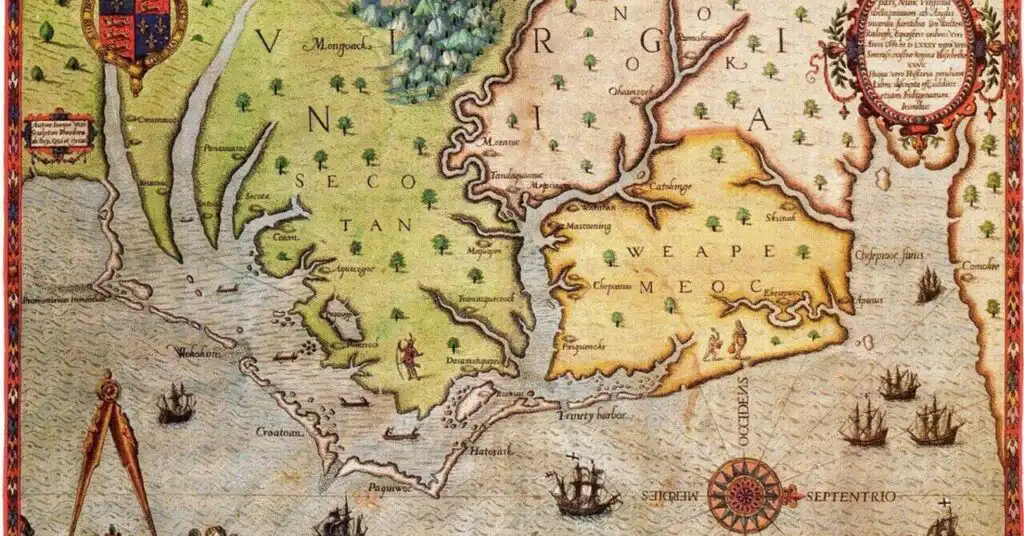
Clues suggesting the colonists did not vanish so much as move inland and blend in. The modern hunt got a jolt in 2011, when researchers examining a watercolor map by John White noticed something hiding under a patch of paper. On a light table, a faint fort symbol appeared at the head of a sound, at a spot where the Roanoke and Chowan rivers meet. It was named Site X, and it sits well inland from the old colony.
Excavations there turned up Tudor pottery and other English objects from the right era, the kind of things a small group of surviving colonists might have left if they lived among the local people. The great difficulty is proving the objects were not left by an earlier English expedition or a later trader, but the pattern fits the idea of a group that integrated rather than disappeared.
Was There Something Bigger Going On?
There was, and it may be the single most useful clue in the whole mystery. In 1998, two researchers named David Stahle and Malcolm Cleaveland studied the growth rings of ancient bald cypress trees and reconstructed the weather of the era. What they found was a genuine drought, and a brutal one. The growing season of 1587, right when the colony was struggling to establish itself, was the driest in roughly eight hundred years. The colonists didn’t just vanish. They walked into the worst drought in centuries, in a land where the local people were already stretched thin.
That changes the tone of the story completely. A colony that couldn’t grow food and couldn’t count on help would have a very practical reason to move inland and throw itself on the mercy of people who knew how to live there. It is less a ghost story than a survival story.
There’s a sad archaeological twist too. The shoreline where the settlement once stood has been eroding for centuries, and the northern part of Roanoke Island lost an enormous stretch of land between the 1850s and the 1970s. Some of the answer, if it exists at all, may already be underwater.
So Where Did They Go?
The strongest theory is that they relocated and were absorbed into local Native communities. Within a few decades of the disappearance, English visitors to the coast were told stories of gray-eyed and light-skinned ancestors among the local tribes, sometimes described as having come from a great ship. By the early 1700s, the people living where the Croatan had been, later called the Hatteras, told settlers their ancestors had once been white.
Whole books have been written claiming the mystery is solved, but many archaeologists are cautious, because “absorbed into a community” is exactly the kind of thing that leaves few archaeological fingerprints. The truth is probably that the colonists survived and merged into the peoples around them, leaving the American imagination with a mystery it has refused to let go of for four hundred years.
It is the same instinct that keeps other vanished stories alive, like the doomed ships of the unexplained disappearances at sea. We seem unable to resist a blank space.
So the Lost Colony may not be lost at all. It may just have done the most understandable thing imaginable, adapted and carried on under a new name. We simply wanted a more dramatic ending…