It’s late, the house is quiet, and then you hear it: that thin, repeating chirp coming from somewhere behind the sofa. You can’t see the little thing, and it simply won’t stop. I don’t know about you, but my first instinct has always been to go hunting for it with a shoe. And then I remember the stories. Because for centuries, in a lot of different places, that sound has been treated as anything but a nuisance. A cricket indoors has been read as a good omen, a sign of money on the way, and in one old tradition, a visitor from the other side. So before you reach for that shoe, maybe give this a read first.
Crickets sit right at the edge of our everyday lives. They live in our walls, they sing in the grass, and they have worked their way into folklore on almost every continent. Here’s the question that brings most people here, though: is it bad luck to kill a cricket? And what does it actually mean when one gets into your house? Let’s dig in.
Why Is a Cricket in the House Considered Good Luck?
Because across Europe, Asia, and North America, a cricket that moves in with you has long been a lucky guest, and one you are meant to keep. In Florence, Italy, the tradition is so old that the city holds a festival every May just for the insect. It’s called the festa del grillo, the festival of the cricket, and it goes back to the days when people kept crickets in little cages as pets and lucky charms. Crickets are considered a sign of good fortune there, as they are in plenty of other parts of Europe and, indeed, all over the world.
The logic runs something like this. The cricket is a creature of warmth and easy living. It only sings when the weather is good and the season is kind. So when you hear one chirping inside your home, the old reading is that comfort and plenty have come indoors with it. Killing it, in that frame of mind, is like shutting the door on your own good luck. It’s the same instinct you’ll find in the old moth superstitions, where the little night visitor is treated less like a pest and more like a polite sign from somewhere else. I have to say, I find that a much nicer way to think about the thing rattling around my lampshade.
Is It Bad Luck to Kill a Cricket?
In most of the old folklore, yes: a cricket in the house is a lucky guest, so harming one is usually read as turning that luck away. The belief is not some universal law with a rulebook, though. It belongs to the same family of ideas as never killing the spider in the corner or the ladybug on the windowsill. The creature has been cast as a small, friendly presence, and you don’t stamp on a guest.
This is where I have to be honest with you, though. If you go looking for a single written law that says killing a cricket costs you seven years of luck, you won’t find one that holds up. What you find instead is the general principle, repeated in a dozen cultures: crickets mean good luck, so leave them be. The “bad luck” is the flip side of the good luck, not a separate curse with its own rules. Practical people have always ignored this, I should add. A house cricket in a kitchen or a bakery has historically been a genuine pest, and the mole cricket has been a real nuisance in gardens. Folklore is one thing; a swarm in the flour bin is quite another, and no amount of good omens is going to save your bread.
Why Do People Keep Crickets in China?
In China, crickets have been prized for more than a thousand years, both as lucky companions and as fighters. Keeping crickets as pets and staging cricket fights is a pastime that was nurtured by Tang dynasty emperors over a thousand years ago and later spread to ordinary people. It’s a gentler sport than it sounds, too. Unlike bullfighting or cockfighting, cricket fights rarely injure the animals, and the contests are more about the insects’ instinct to chirp and square off than about any real bloodshed.
The tradition reaches further than you might expect. In the thirteenth century, the Southern Song prime minister Jia Sidao wrote a how-to guide on the sport, and his obsession with it is said to have helped bring down the empire. The season runs through summer, with championships held after the autumn equinox in late September. The market is serious business, too. In 2010, more than 400 million yuan, close to 63 million US dollars, was spent in China on crickets, and a single champion insect could fetch thousands. Prized crickets have even been given funeral services when they died. When people say a cricket is good luck, this is one place where they have put real money behind the claim.

What Does a Chirping Cricket Mean at Night?
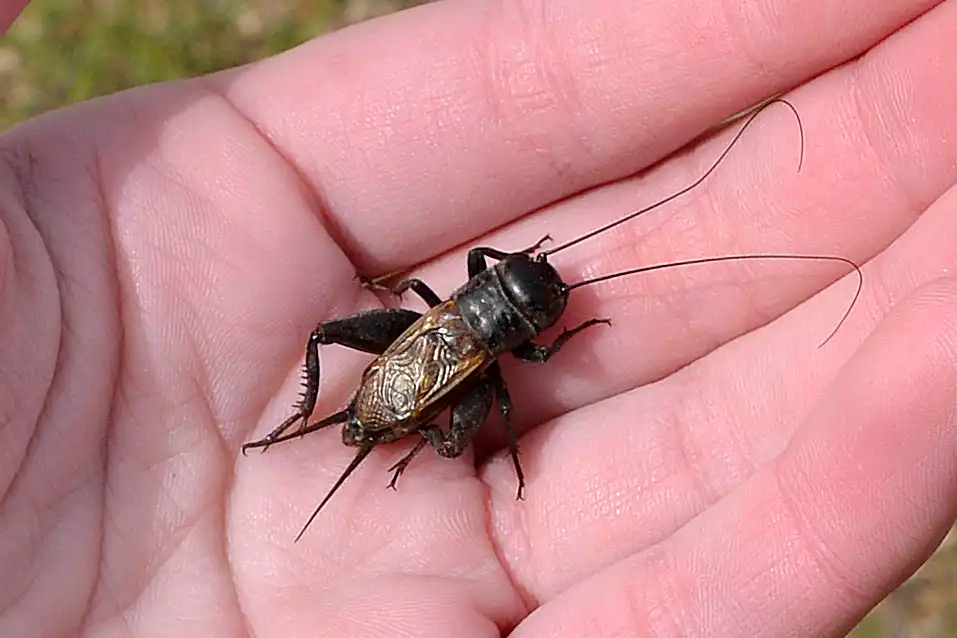
Mostly it means a male cricket is looking for a mate, but the old stories heard more than that in the sound. Only the males sing, and they do it for the same reason a lot of creatures make noise: to advertise themselves. The neat detail is how they do it. They don’t have a voice. They chirp by rubbing a scraper on one wing against a row of teeth on the other, the way you might run your thumb along a comb. The warmer the air, the faster the song. In fact, you can make a rough guess at the temperature in the room just by counting the chirps and doing a little arithmetic, which is a genuinely strange thing to be able to do with a bug. It makes me wish I’d paid more attention in math!
Folklore, though, treated the night song as a kind of message. A cricket singing in the house was company, a warm presence in an empty room, and people have always found that sound oddly comforting. Which is why, in some places, the thing people feared was not the chirping at all… it was the moment it stopped.
Why Is a Cricket a Sign of Death in Some Folklore?
Because in parts of Europe, a cricket that suddenly starts singing, or suddenly goes quiet, was read as a message from the dead. In Silesia, a region of Central Europe, a house cricket heard stridulating was said to signal the presence of a deceased soul. In German folklore, the house cricket, the Heimchen, carried a whole tangle of meanings. Some stories made it a helpful household spirit that could hint at good or bad fortune in advance. Others linked it to the wandering souls of the dead. A cricket that fell silent in a room where someone was sick could be taken as a very bad sign.
It’s worth taking that with a pinch of salt, I think. Death omens attached to animals were often the product of a quiet house, a worried mind, and a coincidence remembered far longer than any time the creature was wrong. And I say that as someone who quite likes a good omen. But the pattern is real, and it runs the full length of this folklore: the same little insect that means good luck in one village is a ghost in the next. If that mix of lucky and eerie appeals to you, the old superstitions are built on exactly this kind of contradiction.
Why Do We Say Jiminy Cricket?
Because the phrase started life as a polite way of swearing. Before it was ever a Disney character, “Jiminy Cricket” was a euphemism for “Jesus Christ”, the same kind of softened oath as “gee whiz” or “crikey”. The expression is recorded in print from the early 1800s, long before anyone had drawn a cartoon insect. It was a minced oath, meaning people said it precisely because it sounded harmless.
The character came much later. Carlo Collodi, the Italian author of The Adventures of Pinocchio in 1883, invented a Talking Cricket who lived in the craftsman’s house. In the original book, the cricket is a strict little voice of conscience, and Pinocchio kills him with a mallet in an early fit of temper. That’s right: the cricket dies in chapter four. He later returns as a ghost to nag the puppet, and finally gets resurrected and given a house of his own. Disney turned that ghostly conscience into the cheerful Jiminy Cricket in 1940, who bears almost no resemblance to an actual cricket. So a phrase that began life as a disguised swear word ended up as a cartoon insect singing about wishing on stars. I love that! Folklore rarely takes a straight road.
Did We Ever Like Crickets Too Much?
There’s a fable about that. Aesop’s tale of the ant and the grasshopper (in some old versions a cicada or a cricket) sets the careful ant against the carefree musician. The ant works all summer, the grasshopper sings, and when winter comes the singer has nothing stored. The story is usually told as a lesson about planning ahead. It’s worth remembering, though, that not everyone read it that way. From ancient times onward, some retellings quietly sided with the cricket, and the argument over whether the artist or the ant has the better life has been running for well over two thousand years.
Did you Know?
You can use a cricket as a rough thermometer. The snowy tree cricket chirps faster as the air gets warmer, and there’s a known bit of arithmetic for turning the chirp count into a temperature. The little singer in your wall is, in a small way, reporting the weather.
So What Should You Do With the Cricket Under the Sofa?
If the old stories have any say, the safest move is the one that takes no courage at all: let it play and get on with your life. A cricket indoors is, in folklore at least, a small piece of good fortune with legs, and the whole tradition leans toward leaving it alone. If it’s keeping you up, a glass and a slip of card will move it outside without any bad luck at all, and you both carry on with your evenings.
The deeper point is that this tiny, noisy insect has managed to mean almost everything to someone. Luck, money, music, a whisper from the dead, even a disguised curse word. We look at a cricket now and see a nuisance on the carpet. For most of history, people heard something else entirely, and honestly, once you know the stories, it’s hard not to hear a little of it too. Which is exactly why I keep the window open on warm nights, and why I always walk the cricket out to the grass instead of reaching for a shoe. Call me sentimental if you like. The cricket, I suspect, doesn’t mind either way. And if it does bring luck, well… mine’s overdue!