Picture a hillside in eastern Turkey on a bright autumn morning. A crew of researchers stands around a drilling rig set up over a long, boat-shaped mound, watching the steel bite into the ground. For a moment everything is going to plan. Then the bit hits something, shudders, and shears clean off. The team will tell you later that they think they struck a layer of hardened wood. Their skeptics will tell you they hit a rock. And that, in one small scene, is the entire history of the search for Noah’s Ark.
You’ve almost certainly seen a version of this story before, because it keeps happening. Every few years, someone announces that the Ark has been found, a camera crew shows up, a headline goes out, and then the whole thing goes quiet again. So what’s actually down there? Let’s walk through it, because the real story is stranger, and a good deal more human, than the headlines let on.
Where Does the Bible Say Noah’s Ark Came to Rest?
Scripture is specific about the region and famously vague about the spot. Genesis says the Ark came to rest “on the mountains of Ararat,” which names a whole highland region, not a single peak. That one phrase is the seed of everything that follows. A range isn’t a coordinate, and two thousand years of searchers have been trying to turn it into one ever since.
It didn’t take long for the two great traditions to settle on different mountains. In the Quran, the Ark comes to rest on al-Jūdī, which most scholars identify with Mount Judi, in the south of the region. The older Armenian and Syriac churches leaned that way too for centuries. Over time, Western Christianity pointed instead at the great twin-peaked summit we now simply call Mount Ararat, the tallest thing in the area and the one that stirs the imagination. So before anyone ever dug a hole, the search already had two addresses, and that split has never fully closed.
People Have Been Looking for It for a Very Long Time
The hunt is far older than the headlines, and I think that’s the first thing worth knowing. A legend from the 5th century tells of Jacob of Nisibis climbing a mountain in search of the Ark, only to be told by an angel in a dream to go no further, and handed a piece of the wood as consolation. The Jewish Talmud tells of the Assyrian king Sennacherib finding a beam from the Ark and turning it into an idol. The first-century historian Josephus wrote that the remains of the vessel could still be seen and shown to visitors, though he gives two different locations in two different books.
Notice what all of those old accounts have in common. Nobody brings it back. Everyone sees it from a distance, or receives a piece of it secondhand, or is told it’s just over the next ridge. That pattern is worth keeping in your pocket, because it’s exactly the pattern we’re still living with now.
The First Real “Photograph” of the Ark
If you want the origin of the modern craze, jump ahead to 1949, when the whole fuss went aerial.
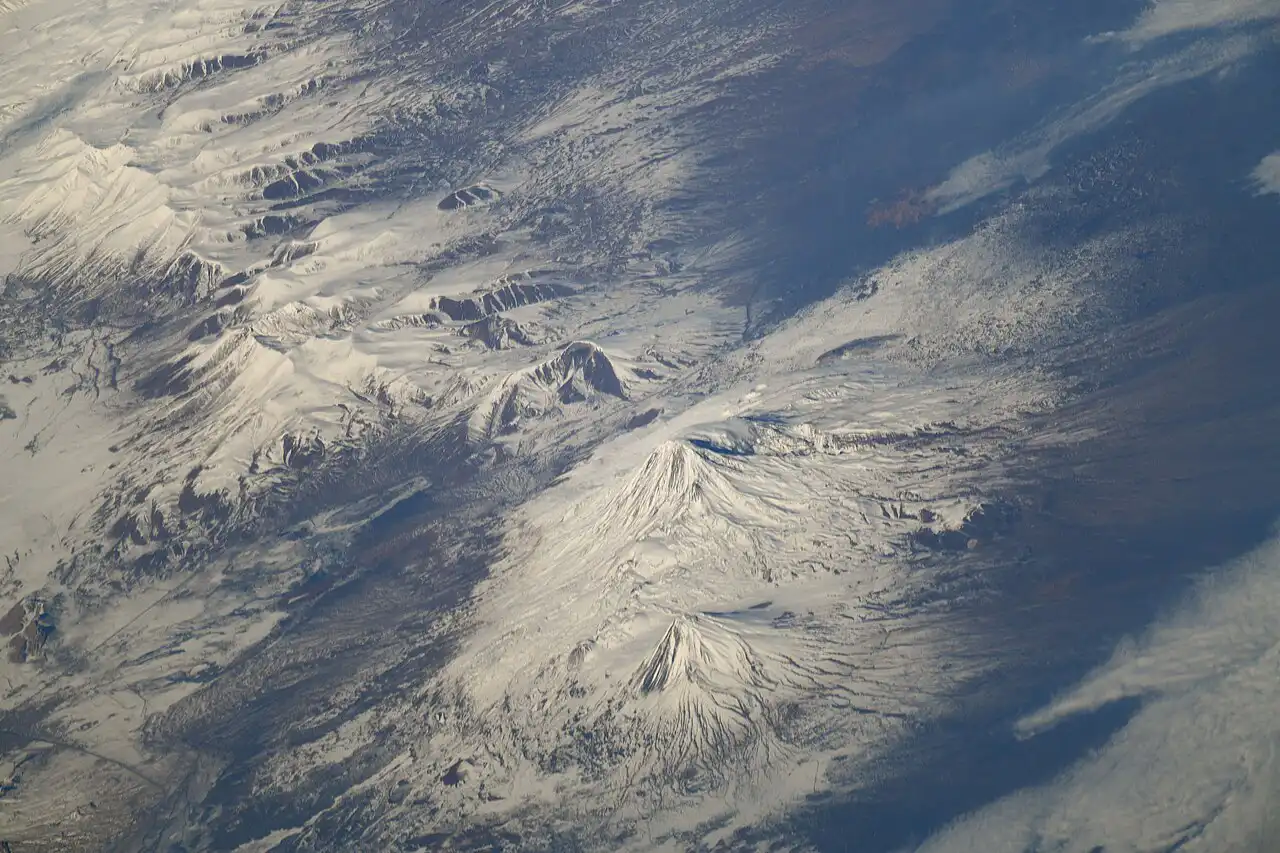
A US Air Force reconnaissance plane photographed an odd shape high in the permanent snow above Mount Ararat, and it has been argued about ever since. The massif sits on the old Turkish and Soviet border, which made it a place of military interest, so those frames and the ones that followed in 1956, 1973, 1976, and the early 1990s were classified. Years later, a curious academic named Porcher Taylor managed to get six frames from that first flight declassified and handed over, and in 2000 a commercial satellite company turned its own lens on the same patch of snow. The thing sitting at around 15,500 feet, a couple kilometers west of the summit, is usually called the Ararat anomaly.

And here’s the honest part. Even in the best of those images, the anomaly is a dark, blurry smudge in the snow. It could be a shadow, a rock outcrop, an ice feature, or the corner of something long and box-shaped. That ambiguity is exactly why it’s never died. A picture clear enough to settle the question would’ve ended the story decades ago, and a picture this unclear keeps the question alive. I’ve looked at the frames myself, and my honest reaction was that I was looking at snow doing something interesting, which isn’t the same as looking at a ship…
The Boat-Shaped Mound Everyone Meets in Photos
Now for the shape you’ve actually seen, the one on all those thumbnails. It isn’t on Ararat at all.
About 18 miles south of Ararat’s summit, near the village of Üzengili, sits a 538-foot mound that looks uncannily like a ship outline from the air. Locals call the area Durupınar. The story goes that earthquakes and heavy rain in May 1948 uncovered the formation from the surrounding mud, and a Kurdish shepherd named Reshit Sarihan came across it. The mound was then spotted from the air in 1959 by a Turkish army captain, İlhan Durupınar, while he flew a mapping mission, and his name stuck to it. When he reported it, a survey team came out in 1960 and started digging.

They dug for two days, and they even dynamited inside it, looking for a hull. What they found was soil and rock. Their official verdict was that the mound was simply an oddity of geology, not the work of human hands, and the site was forgotten again for the better part of two decades. That verdict didn’t hold public attention, though, because the mound was rediscovered by an amateur explorer named Ron Wyatt, who spent the 1980s trying to convince everyone he could that it was the Ark. A salvage expert named David Fasold joined one of those expeditions, looked at the mound, and said it was a shipwreck. They measured it, ran ground-penetrating radar across it, and pointed out that 538 feet is close to the 300 cubits the Bible gives for the Ark, if you use a certain ancient measure. For a while there, it looked like the answer had finally turned up…
Why the Boat-Shaped Mound Is Not a Boat
This is where the story turns, and it turns hard, because the person who did the most to pour cold water on the Durupınar claim was the very man who’d once championed it.
By 1994, David Fasold had changed his mind, and in 1996 he co-wrote a scientific paper calling the whole thing a natural rock formation. The paper’s title pulls no punches: “Bogus ‘Noah’s Ark’ from Turkey Exposed as a Common Geologic Structure.” The formation, the geologists showed, is made of limonite and magnetite in tilted sedimentary layers, the natural product of the local geology rather than a hull with fossilized decks. The so-called anchor stones found nearby, claimed as the weights that once steadied the ship, turned out to be local volcanic rock that could never have been hauled from Mesopotamia. Even the creationist geologist Andrew Snelling, hardly a skeptic of the Flood itself, described the metal-detecting gadgets used at the site as divining rods of the sort you’d see advertised in treasure-hunting magazines. Fasold went back and forth on it before his death, which tells you something about how hard it is to let a find like this go.
So What Is Happening at the Site in 2026?
Which brings us, at last, to the scene we opened with.
A new research effort began core drilling at the Durupınar formation in September 2026, and it has already produced striking claims and stiff pushback in equal measure. The team has reported higher-than-expected organic matter in the soil, possible petrified wood, underground anomalies picked up by radar, and that broken drill bit, which they suspect met a layer of hardened timber. If that is what it is, it would be remarkable. The trouble is that we have stood in this exact spot before, and the scientific community has responded with the same caution it always does. Some outlets ran the discovery as a breakthrough; others ran it as a non-event, with one science site pointedly titled “No, Researchers Haven’t Found Noah’s Ark Near Mount Ararat.” Even figures inside the Ark-believing world have urged calm. The drilling may yet find something that changes the picture. It may also, like every round before it, end with a geologist explaining what limonite does over a few thousand years.
Why the Search Never Really Ends
Because the question is bigger than any one dig, and because people keep finding just enough to keep looking. There’s a genuine human pull here. A boat-shaped hill, a blurry photo, a bit of wood, and the oldest story a lot of us know. Our eyes are built to find shapes, especially the shapes we’re hoping for, which is why you’ll see faces in clouds and ships in hillsides. There’s also a real split in the old records themselves, with one tradition pointing at Ararat and another at Judi, so even a definitive find on one mountain might not settle it for everyone. That combination, a deep hope plus an unsolved map, is a machine for generating new searches forever, and it works the same way it does for the hunt for Atlantis.
Did you Know?
The most famous “photo of the Ark” sat under military classification for decades. Because Mount Ararat straddled the border between Turkey and the Soviet Union during the Cold War, the aerial and satellite images of it were treated as intelligence, not archaeology. The search for a biblical ship got tangled up with spycraft for the better part of fifty years.
So Has Noah’s Ark Been Found?
Here’s where I land, and it’s the same place the evidence keeps landing. No one has produced the Ark. The blurry shape on Ararat has never resolved into anything conclusive, and the much-photographed boat-shaped mound has a strong natural explanation that its own former champion ended up accepting. That’s not the same as saying the Ark didn’t exist, and I want to be careful about that. It means we haven’t found it, and that the finds so far haven’t survived scrutiny, a fate that has befallen plenty of famous discoveries, from the Piltdown Man to a great many sunken ships.
I find that weirdly hopeful, actually. The story’s survived three thousand years without a single confirmed plank of gopher wood, which suggests it was never really hanging on the evidence in the first place. The search keeps going because the hope keeps going, and every so often a fresh crew sets up a rig on a Turkish hillside and lowers a bit toward whatever’s down there. Sometimes it comes back with a smear of something interesting. Sometimes it snaps clean off…
And here’s a last thought to carry with you. We tend to laugh at the people who saw a ship in every bump on a mountain, but the impulse behind it isn’t foolish. It’s the same impulse that keeps anyone digging when the answer matters to them. So when the next headline says the Ark has finally been found, and it will come, maybe the fair thing is to be curious instead of cynical. Between the drilling rig and the lab report, there’s a genuinely open question, and no one, on either side, has actually closed it yet. What do you think they’ll pull up? I know which way I’m quietly rooting.