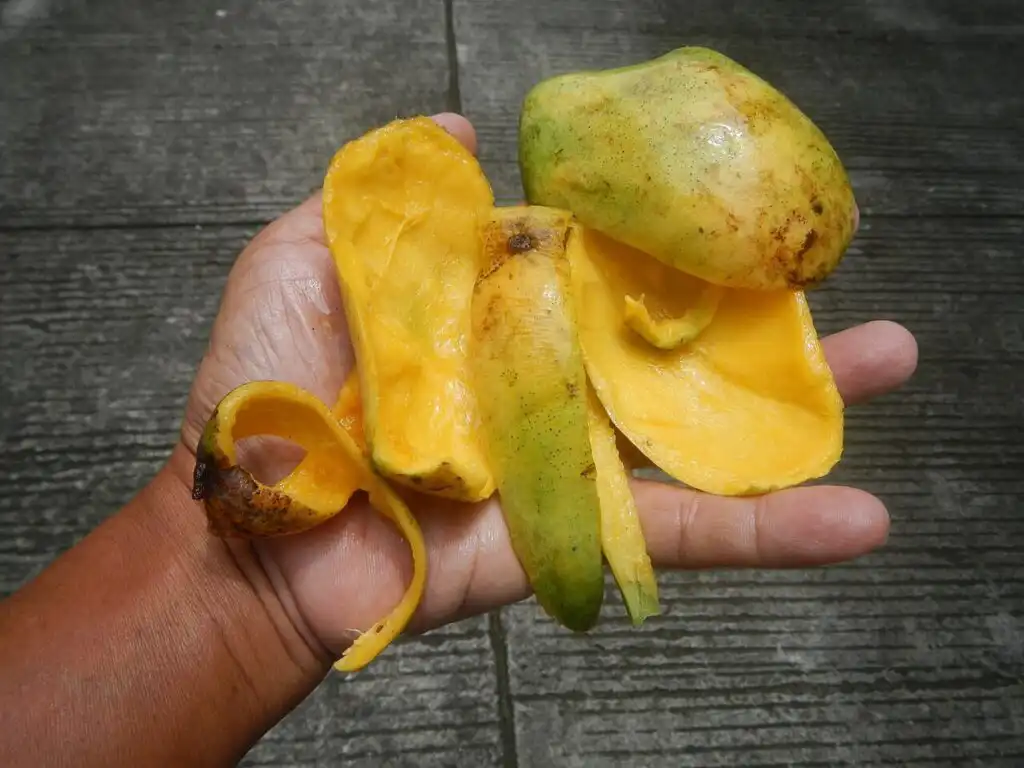
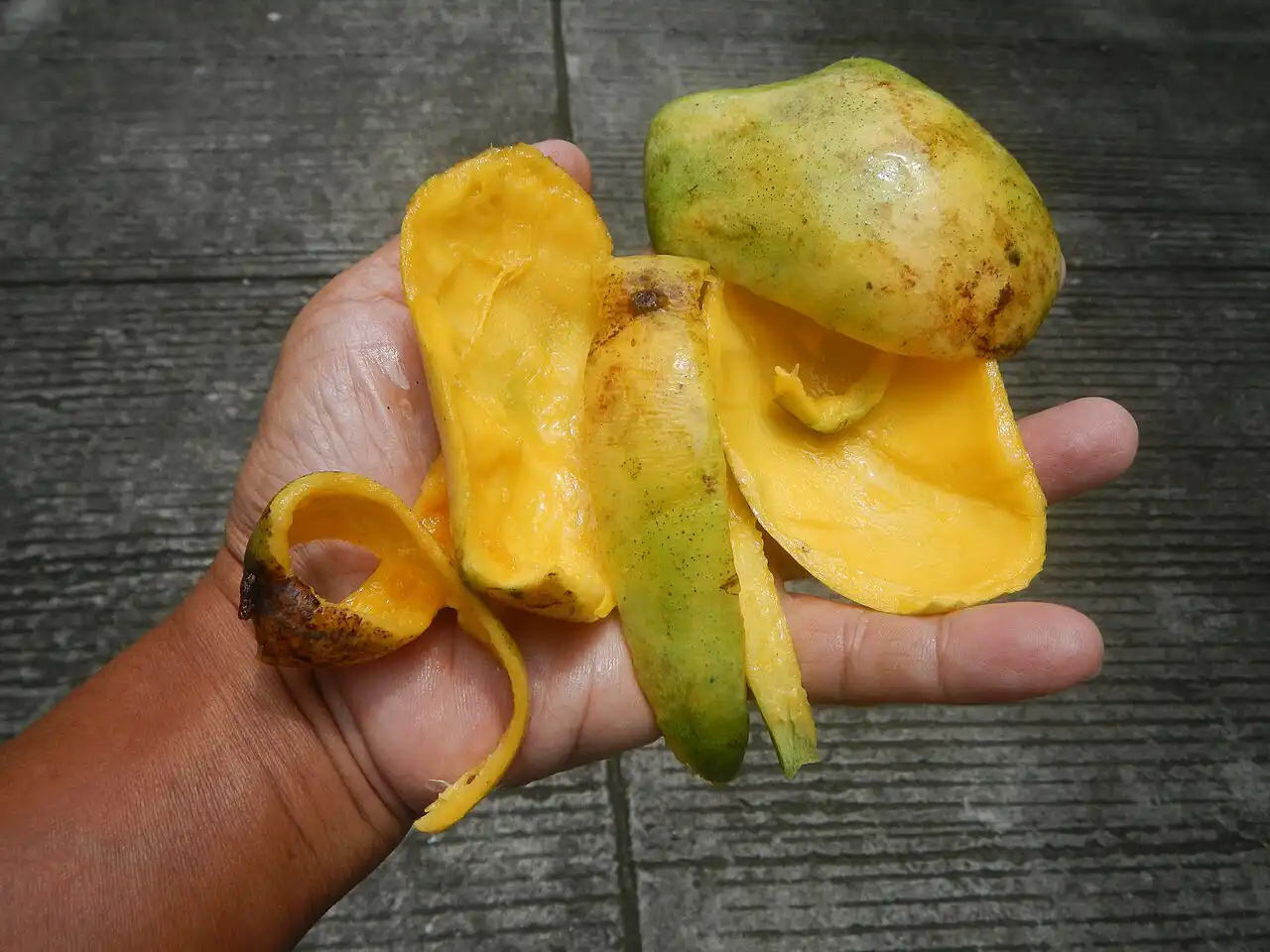
You run the knife down either side of the stone, score the two halves into cubes, and then you’re left holding the last piece, the one still wearing its jacket. Most of us peel that bit and drop it in the trash without a second thought. The mango has a different view of that skin, and the reason is stranger than most people expect: this fruit is close family to poison ivy.
So can you eat mango skin? For most people, yes. But the peel is the one part of the fruit that can hand you a rash… and the story of why is shorter than you’d think.
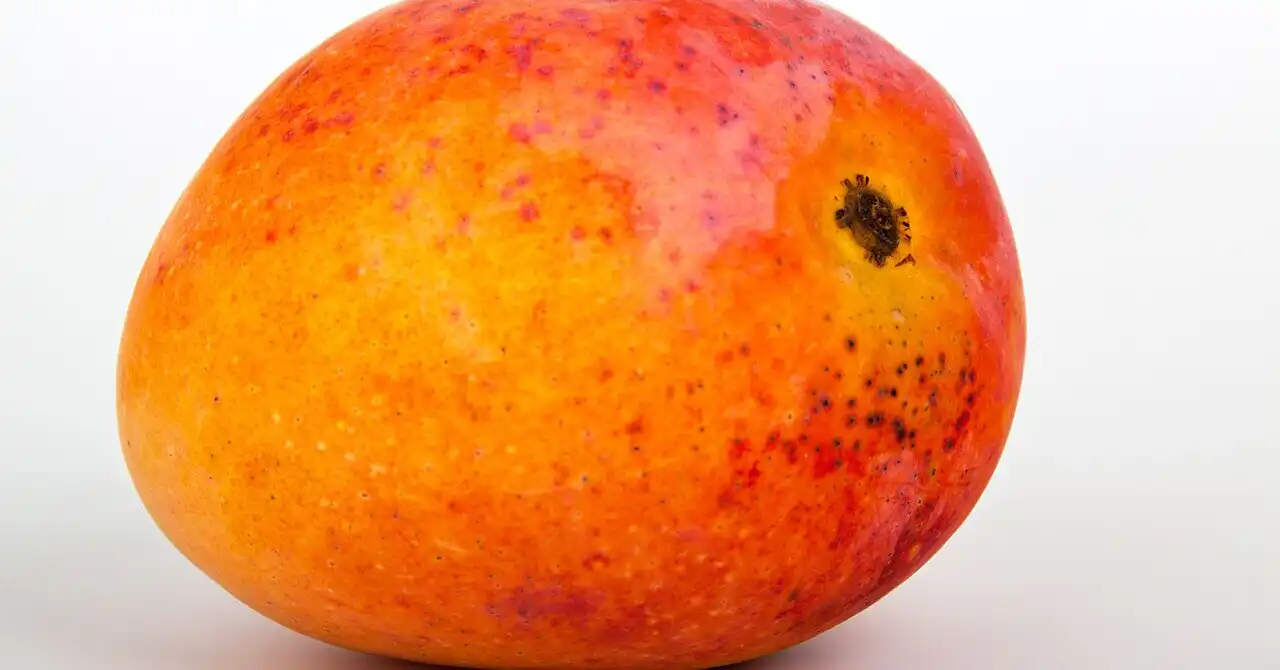
Is Mango Skin Actually Edible?
Yes, and there’s more going on in the skin than in the flesh alone. A mango’s skin is leathery and waxy, which is why it feels closer to a rind than to the skin of an apple, but it’s still food. The peel carries carotenoids such as beta-carotene, lutein and alpha-carotene, along with polyphenols including quercetin, kaempferol and gallic acid. As far as I can tell, it also holds lupeol, a triterpene that turns up in both the peel and the pulp, and mangiferin, a xanthonoid the fruit is known for.
None of that makes the mango unusual. The fuzzy skin of a kiwi, which most people also throw away, is where a good share of its fiber sits, and the same logic runs through plenty of fruit. We peel things out of habit far more often than out of need. Odds are you’ve thrown away the best part of something this week without noticing.
Why Does Mango Skin Make Some People Itch?
Because the peel and the sap carry an oil that the immune system can mistake for poison ivy. A mango plant keeps its allergen in the sap, in the leaves and in the fruit’s own skin, and it brings a rash out in people whose immune systems are already primed to notice it. Those most at risk are the ones who’ve reacted before to urushiol, the oil behind poison ivy, poison oak and poison sumac. Clinicians call it mango contact dermatitis, and it appears wherever the skin met the fruit. After eating that usually means the lips and the corners of the mouth. After peeling it means the hands.
Mangiferin is a second possible culprit, and researchers have recorded the mango version of this reaction overlapping with the poison ivy one. One detail there surprises people: for someone already sensitized this way, even a peeled mango or a glass of mango juice can set it off. The flesh isn’t the safe harbor you’d assume it is.
You can sometimes smell the warning. A ripe mango gives off a resinous sweetness, and that resin is the family trait showing through.
The Mango’s Family Is Full of Rough Company
Mangoes sit in the Anacardiaceae, the cashew family, which runs to roughly 83 genera and 860 species and isn’t a gentle crowd. Poison ivy is in there, along with poison oak and poison sumac. So is the Chinese lacquer tree, whose sap is the reason the word urushiol exists at all, from urushi, the Japanese name for that tree. The same oil, oxidized and hardened, is what gives traditional lacquerware its shine. A chemical that raises blisters on most people is also, with enough patience, a decorative art!
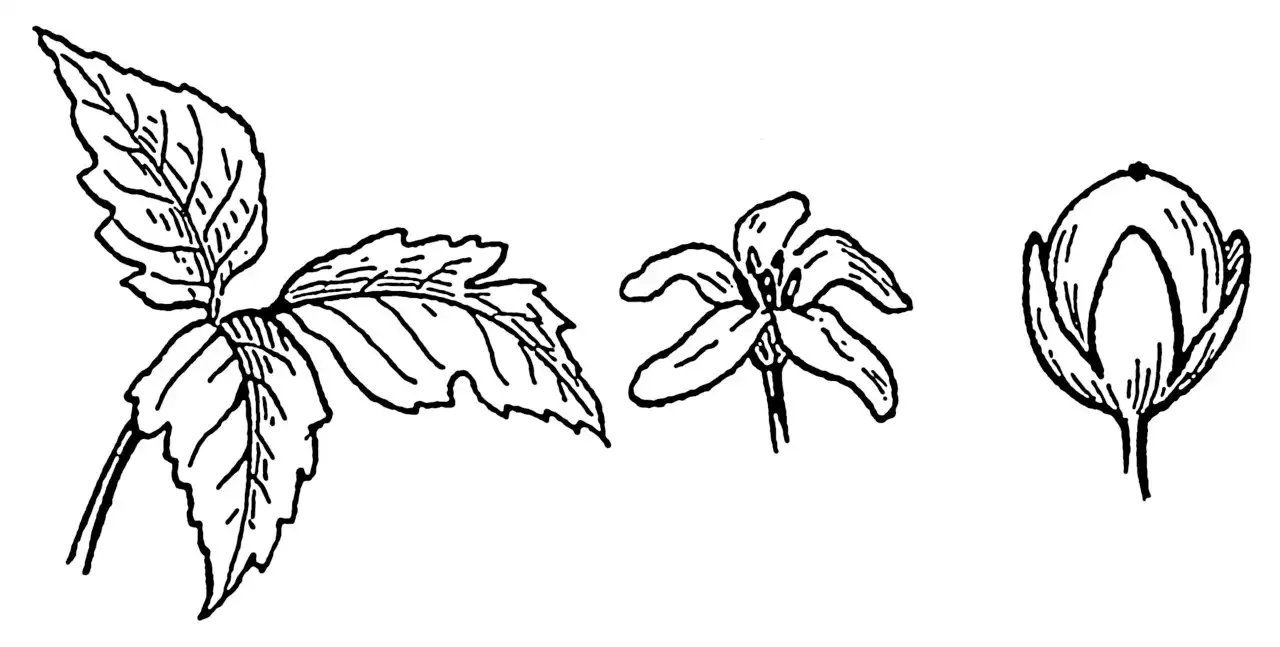
Cashews and pistachios belong to it as well, and so do sumac and the marula tree. If you want the more dangerous end of the same idea, there’s a rogue’s gallery of killer plants worth a read, though the mango isn’t on it. It’ll make you itch. It won’t finish you off.
Why Are Cashews Never Sold in Their Shells?
Because the shell holds a phenolic resin that will blister your hands. The cashew nut sits inside a double shell loaded with anacardic acid, a compound closely related to urushiol, and that’s the whole reason you only ever see cashews already shelled. It isn’t a packaging choice or a shipping convenience (and yes, the same family as the poison ivy in the hedge). The shell is a hazard, and the people who process it treat it like one.
Which makes the mango’s peel look mild by comparison. The mango’s version of the same chemistry is diluted, sitting in the skin and in the milky sap at the stem end rather than in a shell built to stop animals eating the seed.
Who Actually Gets the Rash?
Mostly people who’ve already been sensitized to urushiol, and often not until they’ve eaten mangoes happily for years. An allergy of this kind is built by exposure rather than handed to you at birth, so somebody who’s peeled mangoes since childhood can suddenly find their lips tingling one summer. Reactions run from a mild itch to a spreading rash, and anaphylaxis is possible, though rare.
The advice in that situation is blunt and worth taking seriously: if a mango makes your mouth itch, leave the skin alone and be careful with the juice. If it doesn’t, you’re in the majority, and the peel is simply food you’ve been discarding.
Does Peeling the Fruit Solve It?
Usually, and the stem end is where the trouble concentrates. Wash the fruit before you cut it, take the stem end off first, and keep the sap away from your face until you’ve washed your hands. If you’re going to eat the skin, I’d wash it either way, because the peel is where anything sitting on the outside of the fruit stays.
There’s a mild irony in all of it. The part of the fruit with the most to offer nutritionally is the part we treat as packaging, and the part that can upset a sensitive person is a trace of an oil the plant evolved to stop animals eating the seed in the first place. The mango wasn’t trying to poison anybody. It was trying to be left alone.
A Fruit With a Great Deal of Weight Behind It
Mango is one of the most widely grown fruits on earth, and the numbers are enormous. World production of mangoes, mangosteens and guavas came to 61 million tonnes in 2023, with India growing around 43 percent of it. That’s one country supplying nearly half the world’s mangoes! More than 500 cultivars are known, individual fruits run from 5 to 25 centimeters and from 140 grams to 2 kilograms depending on the variety, and three countries, India, Pakistan and the Philippines, have made it their national fruit. Bangladesh went one further and made the tree itself a national symbol.
The plant began somewhere between northeastern India and Myanmar and has been cultivated for so long that the name worked its way into English from Malay, which had it from Malayalam, which had it from Tamil. Its seeds are recalcitrant, which is the botanist’s way of saying they won’t survive freezing or drying, so every mango you’ve eaten came off a tree somebody planted and looked after. In the Philippines, green mangoes get eaten with salty shrimp paste. There aren’t many fruits with that kind of range.
The Peel Is Worth a Try
If urushiol has never bothered you, there’s no good reason to keep throwing the skin away, and if it has, you already know what to do. I’d start with the gold varieties if you want a gentler introduction, wash the fruit, take a bite and see. The worst case is a tough, faintly bitter mouthful, which is a fair trade for finding out where you stand.
The odd part is how much of this we never notice. A fruit that’s been in kitchens for centuries turns out to be carrying a chemical that sends people running for calamine lotion, and the same chemical is on the front of a lacquer box in a museum, holding its shine… The mango has been keeping odd company this whole time.
I hope that settled it, and maybe changed what you do with the next one. Which leaves the question I keep coming back to: how many other things in your kitchen are quietly related to something you wouldn’t touch with bare hands?