On a summer evening in 1983, three boys slipped into an empty house in Casper, Wyoming, and found a cupboard full of paint. They splashed it across the walls and, inevitably, across themselves. To clean up before going home, they undressed and wiped the paint off with white gas, the volatile camp-stove fuel also sold as naphtha. Then, in the darkness, one of them struck a match. Police arriving at the scene described what happened next in a single phrase: the boys had become one big ball of flames.
Two of those boys were brothers, Jamie and Glen Selby, aged five and seven. They were burned over almost the entire surface of their bodies, and the doctors who saw them gave them next to no chance. What saved them was a discovery made nine years earlier, in a Massachusetts laboratory, in a completely different line of research. A doctor there turned his lab into a nonstop workshop and grew the boys a brand new suit of skin. It is one of the most remarkable medical stories of the twentieth century, and it is entirely true.
How Badly Were the Selby Brothers Burned?
Jamie and Glen Selby suffered third-degree burns over roughly 95 to 98 percent of their bodies. Third-degree means the skin is destroyed through its full thickness, so it can’t heal itself the way a lesser burn can. The wire report filed on July 7, 1983, as the boys were flown from Denver to Boston, described them as being in very critical condition with burns across 95 to 98 percent of their bodies. Their friend Ricky Parras, who was six, had been burned over his entire body and died two days earlier.
For burns that extensive, the usual treatment is a skin graft: take healthy skin from somewhere else on the patient’s body and move it onto the wound. But that only works when there’s healthy skin left to take. With almost the whole body burned, there was nowhere left to harvest from. That’s the dead end that kills people with burns this severe. The patients survive the fire only to die of infection, because the body’s outer barrier is gone and there is no skin left to rebuild it with.
Did you Know?
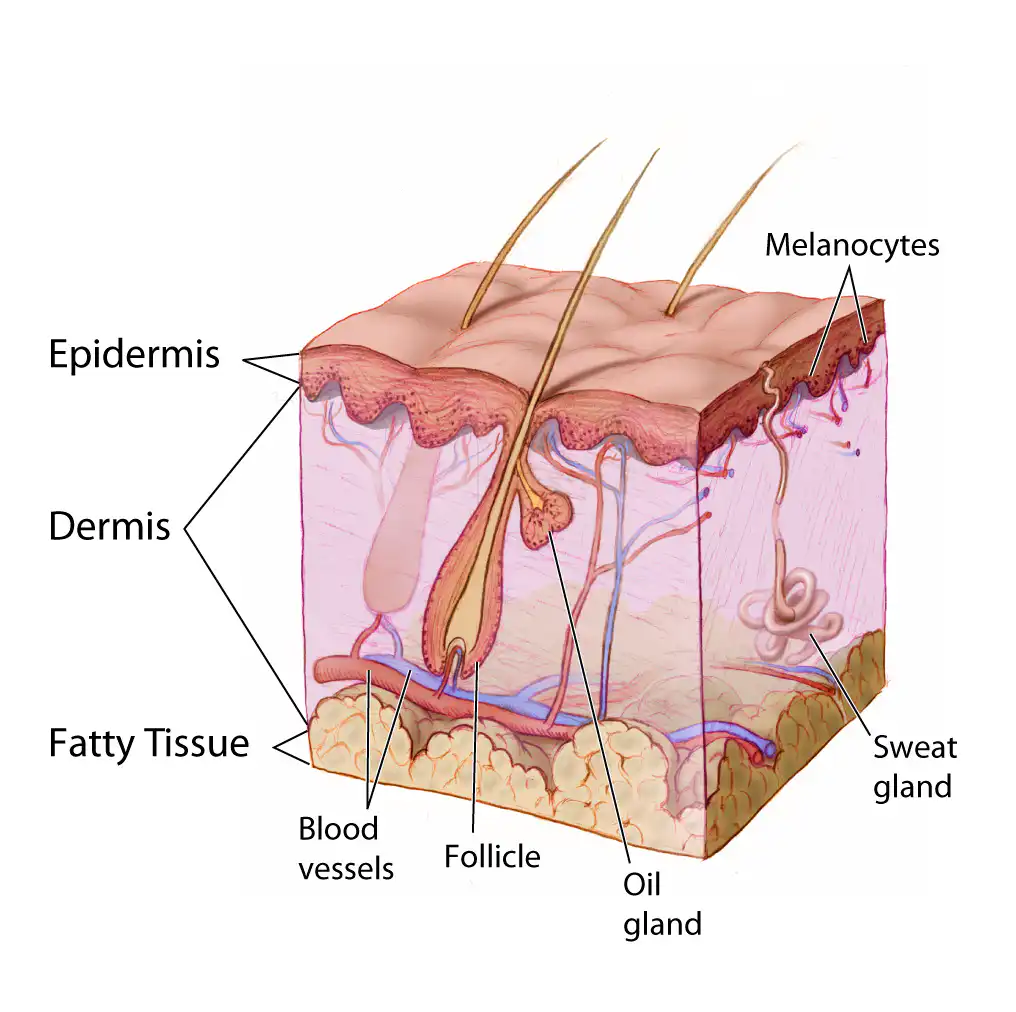
Human skin is the largest organ in the body, and it renews itself constantly. You shed roughly half a million skin cells every day, and over a lifetime you go through thousands of complete sets of outer skin without ever noticing.
You Can Grow a Patch of Skin Into a Whole Body’s Worth
The trick is that skin cells multiply, and a tiny sample contains enough of them to seed an enormous sheet. That same boundary between medicine and the macabre runs through our look at things that get under your skin. Researchers led by Dr. Howard Green, then at Harvard Medical School, had worked out how to take a small biopsy of a patient’s own skin, isolate the living keratinocytes, the cells that build the outer layer, and coax them into dividing in a laboratory dish. Green liked to describe the scale in a way anyone can picture: a biopsy no bigger than a postage stamp could be multiplied until it covered a whole tabletop.

Because the cells came from the patient’s own body, there was no donor and no rejection. The immune system doesn’t attack itself, and that’s the quiet genius of the whole approach. The cure was grown from the person who needed it. For each of the Selby boys, Green’s team took what little unburned skin remained, and set about turning it into enough to cover a child.
For the Selby brothers, that meant making skin at a pace no lab had ever attempted. Green’s Harvard laboratory ran day and night, producing sheet after sheet of the boys’ own cells. I’d call it the strangest kind of factory there is, one that grew a child’s own skin back onto him. Jamie eventually received around 150 grafts, and his brother Glen around 200, with roughly half of all their new skin grown from a laboratory dish. By the standards of the day, it was the largest area of laboratory-grown skin ever grafted onto human patients.
The Accident That Made It Possible
The technique behind that skin was discovered by accident, while studying something completely unrelated. In the early 1970s at MIT, Green and a graduate student named James Rheinwald were studying a type of tumor called a teratoma, which can contain bizarre fragments of teeth, bone, and hair. In the course of that work, Rheinwald noticed living keratinocytes, the building blocks of skin, and the two of them managed something nobody had done before: they got those human skin cells to grow and keep growing in a laboratory.

To keep the fragile human cells alive and dividing, they grew them on a bed of cells taken from mice, a support layer that fed the skin cells without being part of them. Green later reflected on the strangeness of the chain of events: a study of a mouse tumor had led, by a route nobody could have predicted, to a treatment that would rescue burned patients. He said he had never set out to solve practical problems, but when you can multiply a patient’s skin cells by the million in a dish, the obvious next question is what else that could mend.
The answer arrived in a hurry in the summer of 1983. Before the Selby brothers, the procedure had only been tried in small, cautious experiments on limited patches of burns. Nobody had attempted anything on the scale those two boys needed. As the plastic surgeon Dr. Nicholas O’Connor put it at the time, without that laboratory-grown skin the children didn’t have a hope.
Did the Selby Brothers Survive?
Yes. Both Jamie and Glen survived, and each lived for roughly another twenty years. It was an agonizing recovery, built on hundreds of operations and a long, slow process of covering one section of a body at a time. I can’t imagine what those years were like for them. But the boys who weren’t expected to live left the hospital, grew up, and carried skin that had been grown for them from their own cells. Their case became the proof that laboratory-grown skin could save lives on a scale no one had dared to promise.
What happened to them in the end is the part of the story that is least often told. The brothers died in their twenties, and by Dr. Green’s own account the cause lay elsewhere: they died, he wrote, of “complications not directly related to their burns.” That phrasing is worth pausing on. The fire that nearly took them in 1983 did not, in the end, take them. They survived the burns. It was something separate that caught up with them two decades later, and it is a quiet reminder that rescuing a child from the edge of death is not the same as undoing what the fire did.
What This Accident Gave the Rest of Us
Green’s discovery did not stay in one hospital, or in one decade. The same principle, keeping difficult human cells alive so they can be multiplied and returned to the patient, became one of the foundations of stem-cell research and regenerative medicine. Green went on to found a company to spread the technique, and it was later bought by a larger biotechnology firm. The scientists who followed him realized that other kinds of stem cells could be kept alive the same way, by cultivating them alongside supporting cells. Today that idea helps grow corneal stem cells, which restore sight to eyes damaged by chemical burns. It sits alongside the stranger corners of medicine we have explored, like the unsettling question of whether anything can really live inside the human brain.
Fun Facts:
- Cultured epithelial autograft, the technique used on the Selby boys, is now a standard tool in major burn units around the world.
- The supporting layer of mouse cells that Green and Rheinwald used to feed the human skin cells became a model for growing many other cell types.
- Laboratory-grown skin is studied today for treating chronic wounds, reconstructing skin after cancer surgery, and even for growing layers to test cosmetics and medicines without animal testing.
- Every advance traces back to the same simple insight: sometimes the most powerful cure is the patient’s own biology, multiplied outside the body and handed back.
The Skin That Was Already Inside Them
The reason the Selby brothers could be saved is the same reason their new skin fitted them so well: it was their own. A donor could never have covered them, because a stranger’s skin would be attacked and rejected (the same immune matching that decides whether a transfusion can be given), and there was no healthy tissue left on the boys themselves to borrow from. Howard Green’s method sidestepped both problems at once. It multiplied what little skin the boys still had, and since it came from their own bodies, their immune systems welcomed it back. The cure was never really a gift from outside. It was a gift from themselves, just grown in a dish until there was enough of it to cover them.
That’s what makes this story more than a medical milestone. It’s a reminder that the most extraordinary thing a laboratory can do is sometimes simply give the body enough of what the body already knows how to make. Two boys from Wyoming walked out of that crisis carrying new skin their own bodies had produced, a single postage stamp grown into a suit.
I hope this settles a question you never quite got around to asking. One thought to leave you with the next time medicine looks like magic: if the greatest cures so often come from the patient’s own biology, what else already inside us might we only need to learn how to grow?