It’s the last week of August 1835, and you’ve just handed a penny to a newsboy on a New York street corner. The New York Sun is thin and cheap and louder than any paper you’ve read before. On the front page this morning, in type usually saved for wars and shipwrecks, is a headline about a British astronomer named Sir John Herschel. He’s said to have pointed a new kind of telescope at the Moon and seen something nobody had ever seen before.
You’re still reading. There are bison up there! There are goats, and a strange round creature that rolls across the beach, and beavers that walk on two legs and tend fires outside their huts! I mean, why not, right? And then, on the fourth day, the story goes somewhere else entirely. There are people on the Moon! They are about four feet tall, covered in copper colored hair, and they have wings.
None of it was true. All of it was printed. And for a few weeks in 1835, one of the most outlandish stories ever put in an American newspaper was taken seriously by a remarkable number of people who should have known better. This is the Great Moon Hoax, and the strangest thing about it is not the man-bats. It’s why anyone believed them.
What the Sun Actually Claimed Was on the Moon
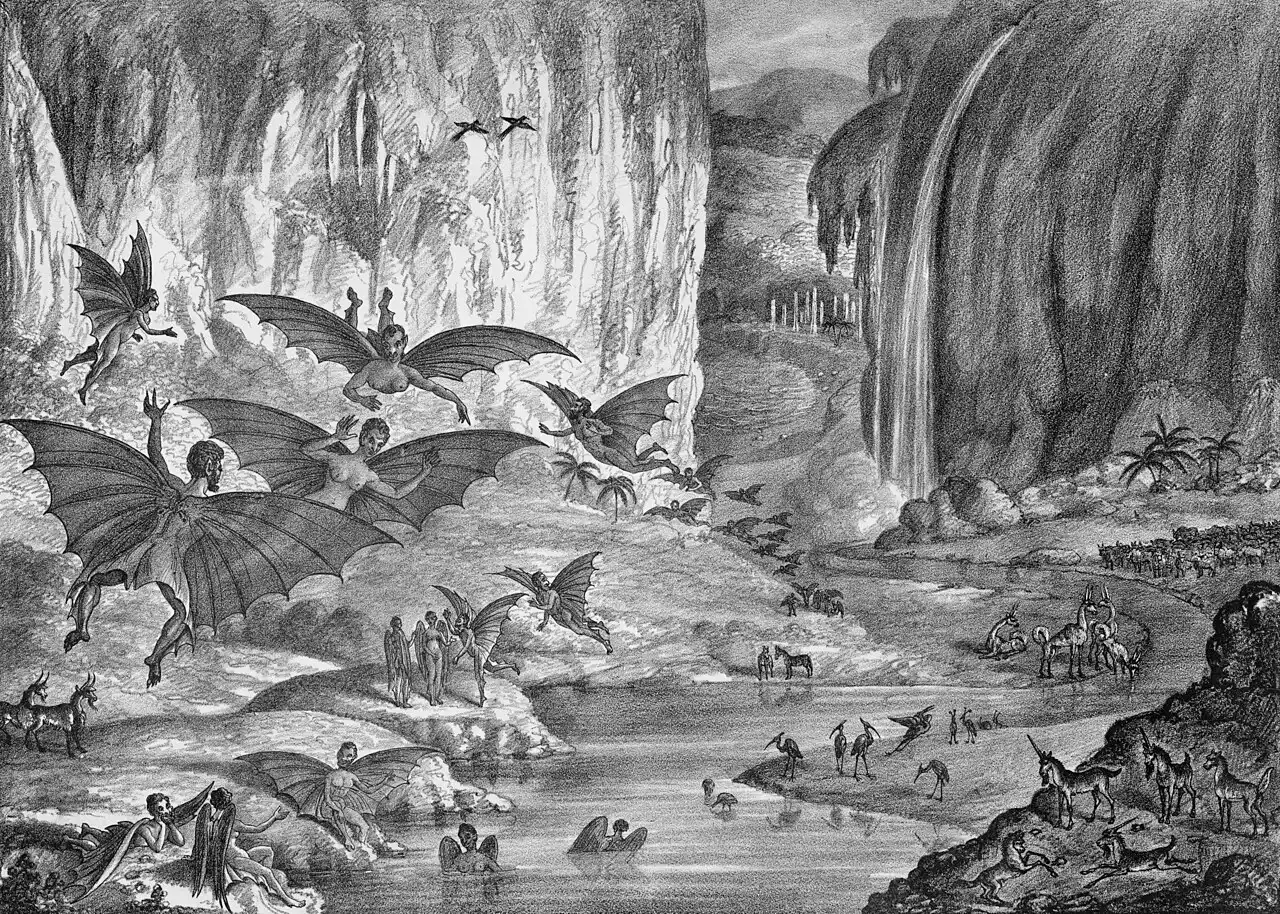
The newspaper didn’t just hint at lunar life either. It described it in detail, over six days, in about 17,000 words. Can you imagine? The series began on August 25, 1835, and ran as extracts that were supposedly pulled from an overseas scientific journal, the Edinburgh Journal of Science. The whole thing was credited to a Dr. Andrew Grant, described as the traveling companion of Sir John Herschel, who was said to have built a telescope with a 24 foot lens and a second device called a hydro oxygen microscope that let him see the Moon as clearly as a nearby field.
What “Herschel” found was a full landscape. There were oceans, beaches, trees, and 38 species of plants. There were herds of brown animals like bison, a blue lead colored goat, and that spherical creature rolling across the shore. Then came the biped beavers, who carried their young in their arms and lived in huts the writer noted were built better than those of many tribes of people. By the fourth installment the story reached its centerpiece: the Vespertilio homo, Latin for man bat. These were winged people who held conversations, built temples, and, the narrative primly observed, behaved in ways that would not quite meet earthly standards of decorum. The fifth installment found an empty temple of polished sapphire. By the sixth, the telescope had conveniently burned up, which meant the observations were over and no further proof would be coming.

Did you Know?
The Great Moon Hoax is often called one of the first works of science fiction ever published, and it came out nearly a century before the phrase “science fiction” existed.
Why the Moon Hoax Worked in 1835
It worked because it arrived at the exact moment the idea became believable, not because it was clever. This is the part the famous version of the story leaves out, and it’s the best part. In 1835 there was no scientific consensus that the Moon was dead. Some of the biggest names of the previous century had argued the opposite. William Herschel, John’s own father, had believed there was life on the Moon and even on the Sun. Edmond Halley had speculated about life inside a hollow Earth. It was an age that still read meaning into the sky, the kind of era where a full moon was enough to blame for a strange night. The idea of lunar inhabitants wasn’t fringe at all. It was a live question, and the experts hadn’t settled it.
On top of that, a popular religious philosophy of the day, natural theology, taught that the study of nature revealed God’s plan, and a common argument ran that a creator wouldn’t make all those worlds and leave them empty. When the Sun told you a famous British astronomer had seen living creatures on the Moon, it wasn’t asking you to believe something absurd. It was confirming something many of them already half expected to be true. The story didn’t have to build belief. It only had to point at belief that was already there.
Who Actually Wrote It, and Why
The author was a real reporter named Richard Adams Locke, and his motives were part mischief and part sales. Locke was English by birth and had moved to New York after his politics cost him jobs back home. He worked for the Sun, and the newspaper’s own account of how it got the story, a “medical gentleman immediately from Scotland,” hid the fact that the words came from the next desk over. Locke didn’t admit to writing it until 1840.
His reasons seem to have been two. The first was to sell papers, which the Sun was very good at. The second was a joke with a point, and I have to admit I admire it. A few years earlier, a German astronomer named Franz von Paula Gruithuisen had published a paper claiming to have seen walls, roads, and cities on the Moon. Locke’s hoax borrowed the shape of that claim and pushed it until it broke, which is a polite way of saying he was making fun of respectable scientists who let wishful thinking get ahead of their telescopes. The Sun had recently launched the first paper anywhere to be sold by newsboys shouting headlines in the street, and a story like this was built to be shouted.
The Clue That Gave the Whole Thing Away
The dead giveaway was that the journal the story claimed to come from no longer existed. The Edinburgh Journal of Science had stopped publishing in 1833, two years before the hoax. Most readers never checked, and the Sun never produced the issue it claimed to have. That got awkward when a story spread that a small group of scientists from Yale had turned up at the office asking to see it (the paper stalled them, of course).
The more serious debunk came from a rival editor named James Gordon Bennett, who had his own reasons to take the Sun down a peg. Writing under the headline “The Astronomical Hoax Explained” at the end of August 1835, Bennett laid out the evidence that the lunar narrative could not be real. He pointed to that small detail about the vanished journal, and he named Locke as the likely writer. The Sun never ran a proper retraction. It simply let the story die and moved on to the next sensation, which is a move modern readers will recognize.
Did the Hoax Really Triple the Sun’s Circulation?
Probably not, and this is where the famous story gets its own facts wrong. The standard telling goes that the Moon Hoax was so gripping that the Sun‘s circulation exploded overnight, proving the terrifying power of a good lie. The trouble is that the Sun was already boasting a huge circulation before the man-bats ever appeared. Two weeks before the hoax started, on August 13, the paper was proudly announcing 26,000 copies a day. The 19,360 figure that gets quoted as proof of the hoax’s impact is actually lower than the number the paper was claiming before it ran.
Put another way, the hoax didn’t make the Sun. The Sun made the hoax. What made the Sun was technology and hustle: new steam powered printing presses that could turn out tens of thousands of cheap copies, and street corner newsboys who shouted the news to people who’d never bought a paper in their lives. The paper already had the reach. The Moon Hoax simply used it. The version of the story we like best, the one where a clever lie brings a newspaper to its knees overnight, is itself a tall tale, and it has been retold for nearly two centuries because it is a better story than the truth.
Why So Many People Believed It
They believed it because it was dressed in the authority of European science, and because the boring parts checked out. The writer mixed wild fantasy with accurate, obscure astronomy. He mentioned a real observation site used by a real French astronomer, and he got the details right. Herschel really was in South Africa at the time, charting the southern stars, and his departure had been widely reported. The name was genuine, the place was genuine, and the narrative carefully said the discoveries had already been published somewhere respectable. For a reader in New York in 1835, there was no easy way to check. You couldn’t look it up. You had to decide whether to trust the paper.
An editor at a rival paper, Asa Greene, later described the mood in the city with a line that’s lasted: to doubt the lunar discoveries was treated almost like a sin, as if you were questioning something sacred. A New York doctor, Meredith Reese, wrote in 1836 that the whole affair was a case study in how easily a confident story could carry a crowd. The pattern is familiar to anyone who has watched a rumor move through a group of people. We are pattern hunting animals, and when a story fits what we already suspect, we tend to ask fewer questions, not more. That instinct doesn’t need to be fooled. It only needs to be flattered.
How Sir John Herschel Reacted
He was amused at first, and then thoroughly tired of it. Herschel was in South Africa when the story ran and had no idea his name was being used this way until an American showman traveling through the Cape handed him a copy. According to one account, Herschel read it, burst out of his room, and demanded to know what on earth it meant. Once it was explained, he laughed and admitted that his real observations would look pretty dull next to the wonders he’d supposedly found.

The good humor wore off. A while later, in a note to his aunt, he grumbled that the silly Moon story had followed him everywhere, showing up in English, French, Italian, and German, which gives you a sense of how far the thing had traveled. His real work at the Cape, serious and useful, got overshadowed for a while by a story about winged people that he’d never written and never claimed.
The Strange Afterlife of the Moon Hoax
The hoax outlived its own exposure and turned into a small industry. It was translated into several languages, including Welsh, and there was even a shorthand edition printed in 1886, decades after the joke had been explained. During the rest of the 1800s, “moon hoaxy” became shorthand for anything dubious, a word Edgar Allan Poe flung at something he disliked. Poe had his own grudge: he claimed Locke’s story was a theft of an earlier Moon voyage he’d written himself, titled “The Unparalleled Adventure of One Hans Pfaall.”
People decorated with it. There was wallpaper printed with the Moon’s inhabitants, and a snuff box bearing the same scene, and both still exist in museum collections. In 1891, workmen tearing down an old building in Brooklyn found a lead box hidden under the cornerstone, placed there in 1835. Inside were coins, some newspapers from that October, and two large engravings of the lunar animals that a famous astronomer had supposedly discovered. The people of 1835 thought the Moon creatures were worth preserving for the future. The future, reading them, mostly laughed.
So Why Do We Still Fall for Hoaxes?
Because the best lies arrive already believing in themselves, and we are the ones who finish the job. The Great Moon Hoax didn’t sneak past a careful public. It met a public that had been told, by serious people, that the Moon might be full of life, and it told them what they already wanted to hear. Richard Adams Locke didn’t invent belief in lunar creatures. He noticed it, dressed it up, and sold it back. That is the quieter and more useful lesson here, and it is why this story keeps being retold even though its most famous detail, the overnight circulation boom, appears to be a myth of its own.
The Moon Hoax has a lot in common with other stories about the sky that we have looked at before, from the strange things that supposedly fall from above to the way a full moon gets blamed for all sorts. And it belongs, in the end, to the same family as the tales of visitors from elsewhere that still pull at us today. If you enjoy watching that instinct at work, the long history of UFO sightings and alien visitations makes an interesting companion piece.
Here’s the part I keep turning over. If a newspaper tomorrow ran a story that confirmed something you already half believe, and dressed it in the right names, how long would you wait before you checked? I’d like to think I’d check straight away. I’m not so sure lol. Thanks for reading, and here’s hoping your news is at least as strange as the truth.