Somewhere on a quiet island in the Indian Ocean, on a morning in August 1883, a sound was made that no human ear had ever been built to survive, and that traveled further than any other sound in recorded history. Picture it: people on a beach three thousand miles away heard it and assumed a ship was firing its cannons. In one of the strangest twists in all of science, the people nearest the volcano heard almost nothing at all. I’ve read about this eruption for years, and it still bends my head every time.
This is the story of the loudest sound ever recorded, and it isn’t really a story about volume. It’s a story about a pressure wave that ricocheted around the entire planet, and about the first time scientists were able to watch a sound circle the globe…
What Was the Loudest Sound Ever Recorded?
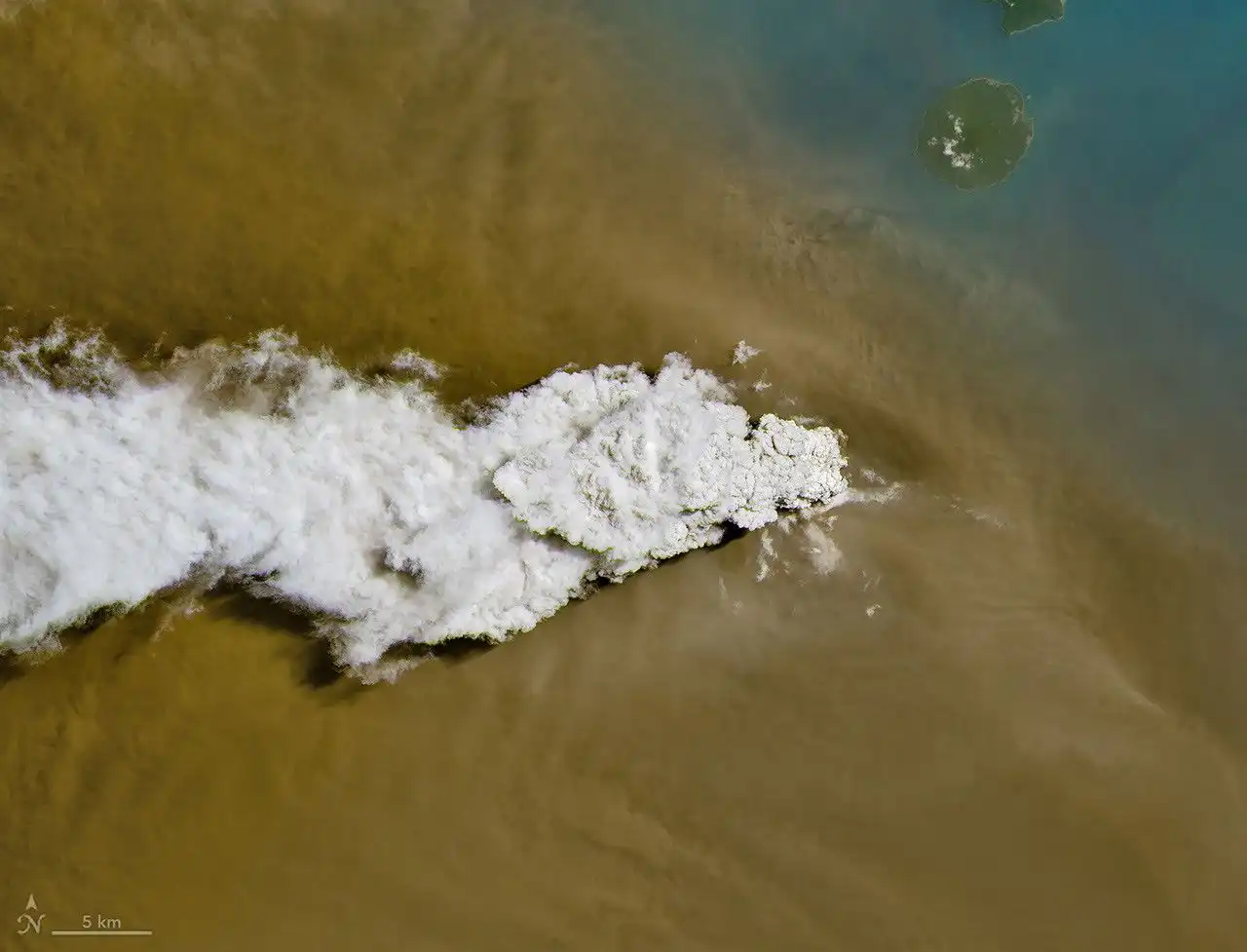
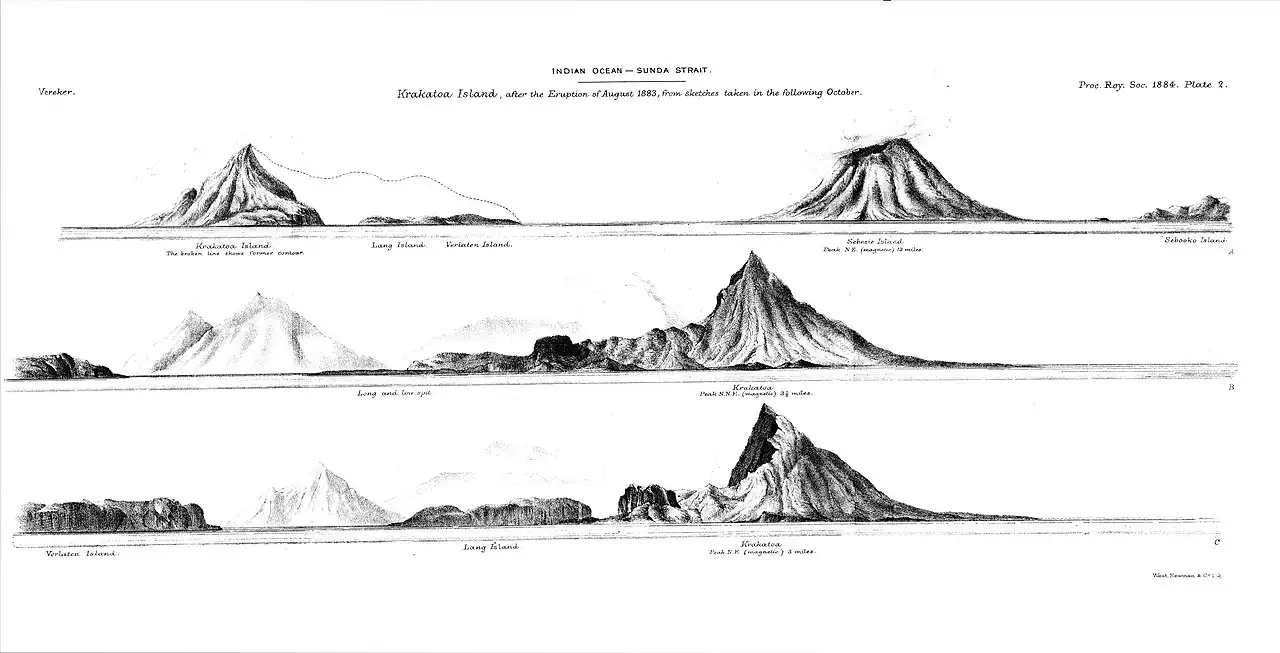
The eruption of Krakatoa on 27 August 1883 produced the loudest sound in documented history, heard thousands of miles away and detected on instruments across the world. Krakatoa was a volcanic island in the Sunda Strait, between Java and Sumatra, in what was then the Dutch East Indies and is now Indonesia. It’d been rumbling for months, but the climax came that morning, when a series of explosions tore the island apart. Over seventy percent of it collapsed into a caldera, and the eruption was later rated a six on the Volcanic Explosivity Index.
The energy involved is hard to picture. Estimates put the blast at the equivalent of about 200 megatons of TNT, roughly four times more powerful than the Tsar Bomba, the largest nuclear weapon ever detonated. Material was thrown out at around 2,575 kilometers per hour. There wasn’t a sound-level meter anywhere on Earth in 1883, so the loudness has been calculated rather than measured, and the figures vary between sources, but the blast at a distance of 100 miles has been estimated at roughly 180 decibels. For context, a jet engine at close range is about 140, and the threshold of pain is around 130, so you’re well past the point where it hurts.
How Far Away Could the Sound Be Heard?
It was heard in Perth, Australia, 3,110 kilometers away, and on the island of Rodrigues near Mauritius, about 4,800 kilometers away, where people thought it was cannon fire from a nearby ship. Because sound travels at a fixed speed, those distant listeners almost certainly didn’t hear it until nearly four hours after the eruption. Sailors on the ship Norham Castle, hove to about 64 kilometers from the volcano, had their eardrums ruptured by the pressure wave. At Batavia, now Jakarta, about 160 kilometers away, the blast sent a gasometer pressure gauge off its scale, burst windows, and cracked walls.
Here’s the part that always gets me. Near the volcano itself, many people heard far less than those at a distance, and some heard nothing at all. The leading explanation is that the loudest explosions were focused upward and outward, projecting the sound into the stratosphere, where it was partly reflected away by suspended ash. The result is a sound that grew clearer the further you were from it, which is about as backward as physics gets. One of the great mysteries of the event is that a catastrophe this loud could, in places, have gone almost unnoticed.
The Sound That Circled the Earth Three and a Half Times
The pressure wave from Krakatoa was recorded on barographs around the world, and one wave was logged circling the globe three and a half times. That’s the part that turned the disaster into a landmark of science. Barographs, instruments that record air pressure, picked up the rippling pulse of the eruption on the far side of the planet. Several recorded the wave seven separate times over five days, four times traveling away from the volcano to its antipodal point on the opposite side of the Earth, and three times traveling back. That’s how scientists could prove the sound had gone all the way around the world and kept going, still detectable five days later.
Smaller ripples were even recorded on tidal gauges as far away as the English Channel, likely from the concussive air waves rather than the tsunami itself. Weather watchers of the day, noticing the strange high-altitude flow of volcanic dust, gave it a name: the “equatorial smoke stream”. In trying to explain the loudest sound in history, they’d also stumbled onto the first identification of what we now call the jet stream.
What Else Did Krakatoa Do to the World?
It killed tens of thousands of people, cooled the planet for a year, and painted red sunsets right across the globe. The official death toll was 36,417, and there were no survivors at all from the three thousand people on the island of Sebesi, which sat close to the volcano. Around a tenth of the dead were killed by pyroclastic flows, the superheated clouds of ash and gas that raced across the sea for up to eighty kilometers, incinerating villages on southern Sumatra. The tsunamis were staggering: a 46-meter wave destroyed the town of Merak, and some reached more than thirty meters.
The global aftermath was gentler but weirder. The following year, average Northern Hemisphere summer temperatures dropped by about 0.4 degrees Celsius, a genuine volcanic winter. Sunsets turned spectacularly red for months, vivid enough that fire brigades in New York, Poughkeepsie and New Haven were called out by people convinced the sky was on fire. There were blue and, on occasion, green moons for years, because fine ash particles scattered red light and let the other colors through. The British artist William Ascroft made thousands of color sketches of the sunsets. In 2004, an astronomer proposed that the lurid red sky in Edvard Munch’s 1893 painting The Scream was painted from memory of post-Krakatoa skies over Norway. The eruption even shifted the Earth’s axis slightly.
The 1815 eruption of Mount Tambora was the largest of the modern era and caused the “Year Without a Summer” in 1816. But it is Krakatoa, not Tambora, that holds the record for the loudest sound. Bigger and louder are not the same thing.
So How Loud Was It, Really?
Loud enough to be heard across an ocean, to circle the planet, and to leave the world a slightly stranger place for a decade. I should be honest that the numbers are softer than they look. There was no instrument capable of measuring a sound this large, so every decibel figure you see is an estimate, and they range widely depending on the source. What’s beyond doubt is the reach: the wave on the barographs, the ruptured eardrums, the cannon fire mistaken three thousand miles away.
The thing I keep returning to is the reversal. We assume an explosion is loudest at its center, and Krakatoa says the opposite. People standing close enough to die from it heard less than a sailor listening four hours later on the other side of an ocean. If you want to wander into the other odd corners of the natural world, there are plenty of unexplained phenomena that break our expectations the same way. Nature rarely respects the rules we invent for it, and it seems it doesn’t obey the acoustics either… Next time you hear thunder from a storm, spare a thought for the morning in 1883 when the sky circled its own sound three and a half times, and ask yourself what else it might have been up to.