Imagine a wall of dark syrup, twice as tall as a man, moving faster than you can run. It doesn’t look like water and it doesn’t sound like water. It sounds like a train, then like a machine gun, and then it hits. People near the Boston waterfront on that winter afternoon had about ten seconds to figure out what was happening. Most didn’t get even that. I’ve read this story more times than I can count, and that ten-second window still stops me cold.
What rolled through the North End on January 15, 1919, was molasses. Millions of gallons of it, from a tank that gave no real warning before it tore itself apart. Twenty-one people died. About 150 were hurt. And the strangest part isn’t the number. It’s that it could have been prevented about six different ways, and everyone involved knew it.
Let’s get into it, because this is one of those disasters that sounds like a tall tale until you look at the paperwork.
What Was the Great Molasses Flood?
On January 15, 1919, a giant tank of molasses burst in Boston and sent a wave of syrup through the streets, killing 21 people. It’s known as the Great Molasses Flood, and it remains one of the oddest industrial disasters in American history.
The tank held something like 2.3 million US gallons, roughly 13,000 tons of molasses. It stood 50 feet tall and 90 feet wide, right next to Boston Harbor. When it failed, all of that weight had to go somewhere, and it went into the neighborhood.
Why Was There a Tank of Molasses By the Harbor?
Because molasses was not a food product here. It was a wartime industrial chemical. Molasses ferments into ethanol, and ethanol was a key ingredient in munitions. The Purity Distilling Company stored it at the harbor so it could be offloaded from ships and piped across the river to an ethanol plant in Cambridge.
So picture it for a moment. The war in Europe had just ended, the country was moving toward Prohibition, and a company was racing to turn a sticky byproduct into the stuff that fills shells. That’s the context. The tank wasn’t a factory for pancakes. It was part of the machinery of war.
The Eighteenth Amendment was ratified the day after the flood, and took effect a year later. Purity had a reason to push the tank hard, and it did.
Why Was the Wave So Deadly?
Because molasses isn’t a normal liquid, and it doesn’t behave like water when it moves. It’s what chemists call a non-Newtonian fluid. Under stress and heat, it thins and flows fast. When it slows down and cools, it turns thick and heavy again.
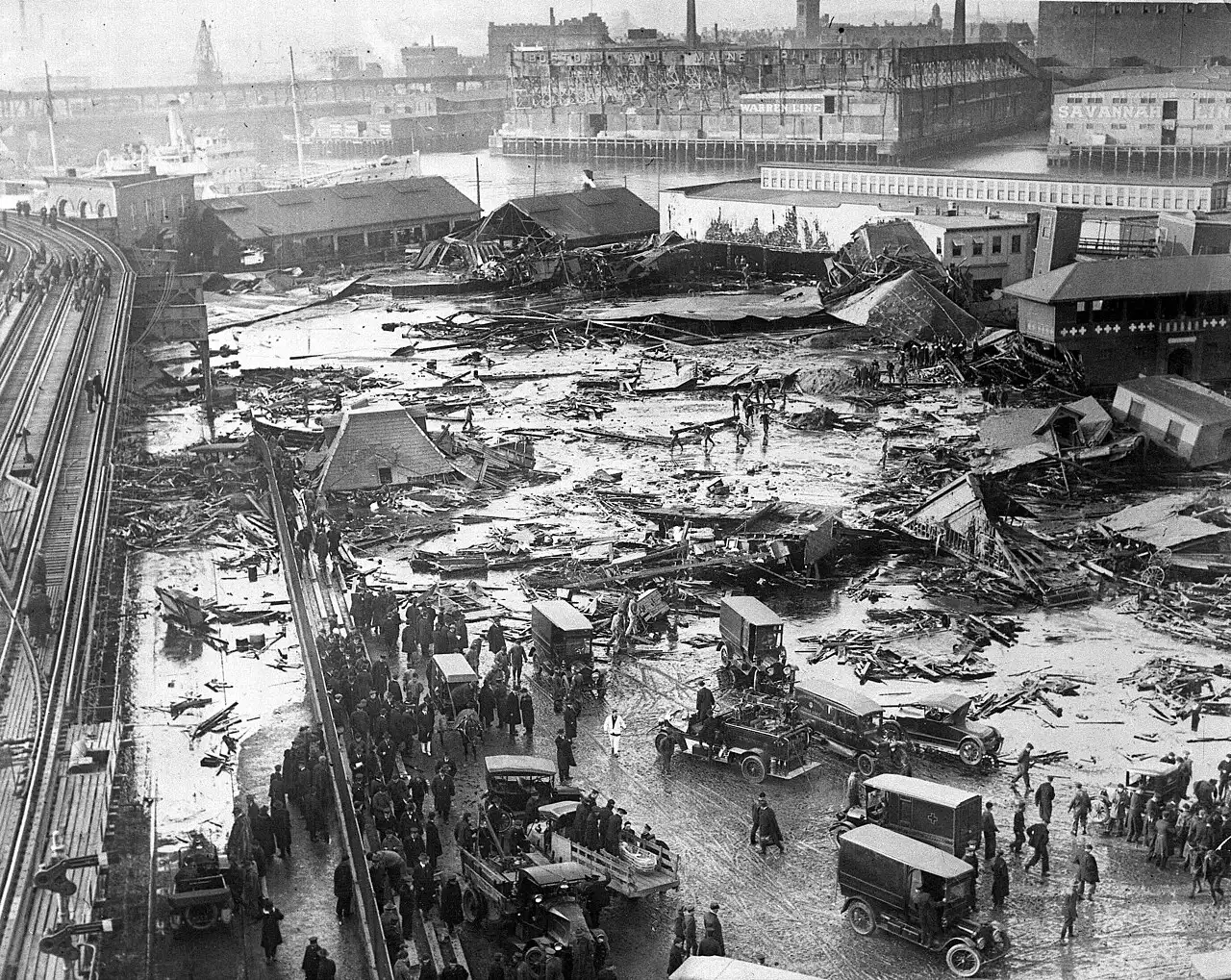
That combination is genuinely nasty. The wave hit at an estimated 35 miles an hour and reached about 25 feet at its peak. Then, as it spread into the cold winter air, it thickened and trapped everyone still caught in it. Rescuers had to dig people out of a substance closer to wet concrete than to a puddle.
I have to hand it to the folks at Scientific American, who put the danger in plain terms: a wave of molasses is more devastating than a typical tsunami, because it hits fast and then sets. The same property that makes it flow is what makes it lethal.
If you like stories where ordinary physics suddenly turns against us, you’ll enjoy the similar puzzle of whether trees can genuinely explode. Nature has a habit of breaking its own rules.
What Did Witnesses Say It Sounded Like?
They compared it to a train, a thunderclap, and gunfire all at once. The description that stuck, though, was the rivets. As the tank split, its steel rivets shot out like bullets, and witnesses said the sound was like a machine gun going off.
As the Globe put it at the time, people were “picked up by a rush of air and hurled many feet.” A truck was lifted and thrown into the harbor. The Boston Elevated Railway’s tracks, right beside the tank, were hit so hard that a streetcar was knocked off them for a moment.
One detail I can’t get out of my head comes from a man named Anthony di Stasio, who was walking home from school with his sisters. The wave picked him up and carried him on its crest, almost like he was surfing, then dumped him and rolled him along before he passed out. He woke to find three of his four sisters standing over him… and no idea, for a moment, where he was. His throat was so clogged with molasses he hadn’t been able to answer when his mother called his name.
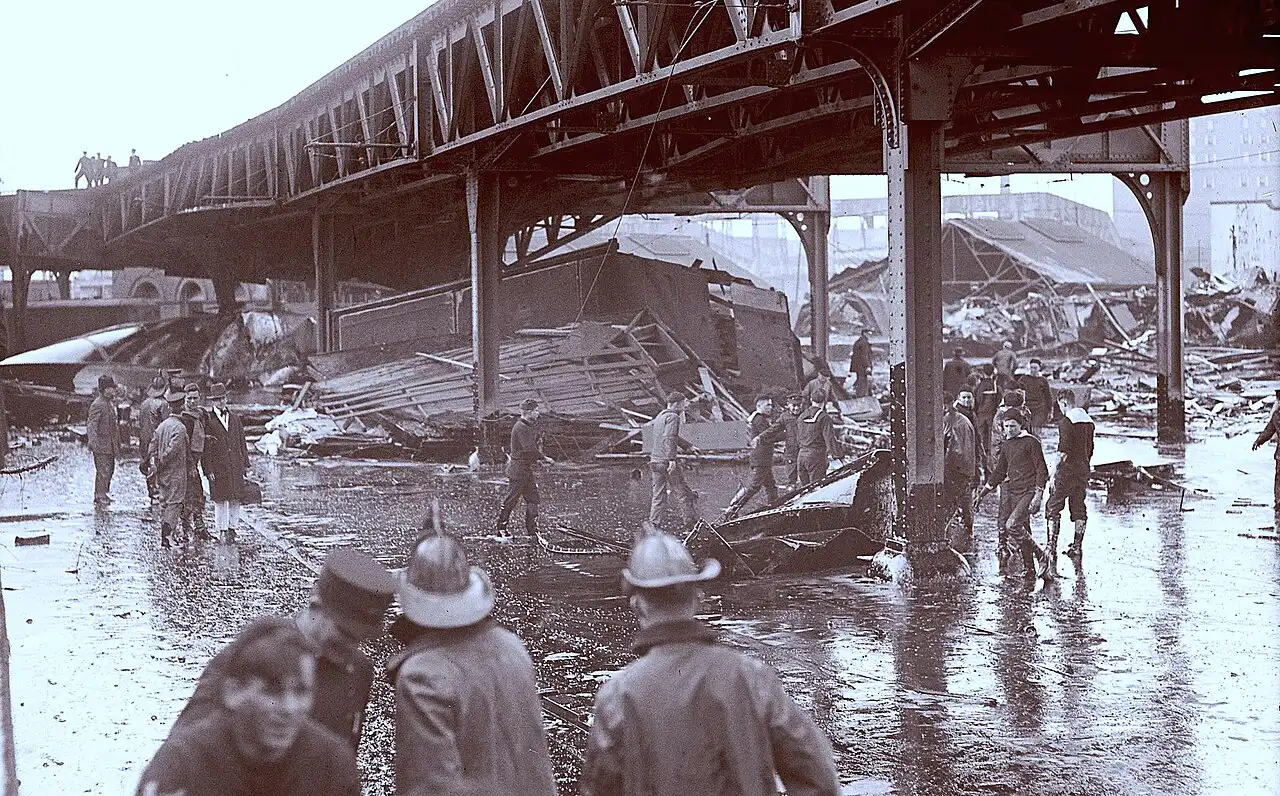
Rescuers washed the streets with salt water from a fireboat and spread sand to soak up the mess. The harbor stayed brown with molasses until summer, and for years afterward Bostonians swore the North End still smelled sweet on hot days.
Could the Tank Have Been Built Better?
It could hardly have been built worse. The tank leaked from the day it was first filled in 1915. It was so obviously seeping that workers painted it brown to hide the stains, and locals collected the free molasses dripping from the seams. That should tell you everything about the safety culture around it.
The man overseeing its construction, the company treasurer Arthur Jell, had no engineering background at all. He skipped basic safety tests, like filling the tank with water to check for leaks, and ignored the groaning sounds it made every time it was filled.
A 2014 engineering review found the plate steel was roughly half the thickness a tank this size needed, even measured against the looser standards of the day. It was also missing manganese, which made it more brittle. The cracks started at the rivet holes. This wasn’t bad luck. It was a countdown that everyone could hear.
What Finally Broke the Tank?
A sudden warm spell, on top of a fresh load of warmed molasses. Boston had been bitterly cold, then the temperature jumped from about 2 degrees Fahrenheit to 41 degrees in a single day. A ship had just unloaded new molasses that was heated to make it flow more easily.
That combination put extra pressure on a tank that was already cracked and undersized for its job. Around 12:30 in the afternoon, it gave way near the base. The newer, thinner molasses mixed with the older, colder stuff, the pressure spiked, and the tank burst.
Modern engineers have since run the numbers and confirmed the physics. Students at Harvard even built a scale model of the neighborhood and flooded it with cold corn syrup to test how fast the wave traveled. Their conclusion: the eyewitness accounts of the speed were credible.
Who Was Held Responsible?
The company, after years of denial and one of the first big class-action lawsuits in Massachusetts. United States Industrial Alcohol, which owned the tank, argued that anarchists had blown it up on purpose. That claim fell apart under scrutiny.
A court-appointed auditor spent three years on hearings and found the company responsible. It paid out around $628,000 in damages, a sum worth roughly $11.7 million today. Families of the dead received about $7,000 each, which is around $130,000 in modern money.
What I find remarkable is that the case became a milestone in American corporate regulation. It helped establish the idea that a company could be held liable for negligence on this scale, and it pushed through real changes to building codes. If you’ve ever wondered why big construction projects need a licensed architect and a civil engineer to sign off, this disaster is one of the reasons. One of the many places where the ground opening up beneath a city forced the rules to change is this same era of American history.
Where the Tank Stood, Today
It’s a baseball field and a playground now, and the tank’s base is still down there. The old property became a railway yard, then a city recreation complex called Langone Park. There’s a plaque, a Little League diamond, and bocce courts on top of one of the worst industrial accidents in the city’s history.
For the 100th anniversary in 2019, ground-penetrating radar located the exact footprint of the tank. Researchers found its concrete base about 20 inches under the baseball diamond. People stood in a circle on the field, marking the tank’s edge, and read the 21 names aloud.
The smell took longer to leave than the tank did. Journalist Edwards Park wrote that it lingered for decades as a distinct and unmistakable part of the North End. Imagine living somewhere for the rest of your life where a hot day brings back the smell of the thing that killed your neighbors… I can’t imagine ever getting used to it.
Why This One Still Gets Me
Because it’s a disaster made entirely of small, ordinary shortcuts. Nobody set out to kill anyone. A treasurer skipped a test. A tank leaked and got painted over. Somebody kept filling it because the war needed ethanol and the deadline was real. Each choice on its own looked minor. Stacked together, they added up to a wall of syrup moving at 35 miles an hour.
That’s what makes the Molasses Flood so unsettling to me. The real lesson here is bigger than a rare freak event. It is about what happens when enough people decide that the warning signs can wait until tomorrow, and tomorrow turns out to be January 15th.
Thanks for reading. Next time you pass a big industrial tank and hear it groan, maybe give it a little more respect than the Purity Distilling Company did.